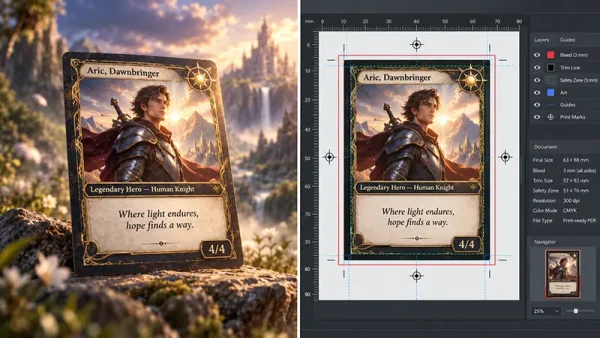
Written by Alex Deng, Production Manager at ACELION, with 12 years of experience in card manufacturing, serving creators, publishers, and international brands. Over the past decade, I’ve seen countless brilliant designs ruined by a simple misunderstanding of prepress mechanics. This guide is built directly from the factory floor to help you bridge the gap between digital design and physical mass production.
Here is a structured technical breakdown of standard playing card dimensions, prepress requirements, and material specifications.
When manufacturing 500 to 50,000 decks, a single millimeter of error in digital file sizing can compromise an entire production run.
Misaligned borders, text clipped by die-cutting machinery, and warped cards are common pitfalls of improper prepress setup.
This guide provides the exact physical parameters required to ensure flawless OEM mass production, saving you from costly reprints and fulfillment delays.
Standard Playing Card Dimensions
Selecting the correct physical dimension is the first step in the manufacturing process.
The dimensions dictate not only the gameplay experience but also the layout on the master printing sheet and the compatibility with automated shuffling equipment.
Factory Note: Always specify paper grain direction relative to your card dimensions. For standard 2.5″ x 3.5″ poker cards, the paper grain must run parallel to the 3.5″ edge (long-grain). If a manufacturer runs it short-grain to squeeze more cards onto a master sheet and save money, the final cards will lose their snap and warp rapidly during shuffling.

Technical wireframe comparing standard poker and bridge size card dimensions for bulk printing
2.5″ x 3.5″ (63mm x 88mm): The Industry Gold Standard
This is the absolute baseline for casino playing cards and major Trading Card Games (TCGs).
- Aspect Ratio: The 2.5″ x 3.5″ footprint provides the optimal surface area for complex artwork while maintaining a standard aspect ratio required by commercial card shuffling machines.
- The Benefit: Sticking to this exact dimension ensures seamless compatibility with standard aftermarket sleeves and automated shufflers, maximizing long-term player satisfaction and retail viability.
- Application: Standard playing cards, TCGs, and collectible foil cards.
2.25″ x 3.5″ (57mm x 87mm): Bridge Size for Board Game Components
Bridge size cards are exactly 0.25 inches narrower than standard poker cards.
- Ergonomics: The narrower width allows players to comfortably hold larger hands of cards (often 10+ cards simultaneously).
- The Benefit: This specific footprint saves critical table space and significantly reduces hand fatigue during complex, long-session strategy games, leading to better reviews from hardcore tabletop gamers.
- Application: Euro-style board games, strategy game components, and compact travel decks.
| Format | Dimensions (Inches) | Dimensions (Millimeters) | Primary Use Case |
|---|---|---|---|
| Poker / TCG | 2.5″ x 3.5″ | 63mm x 88mm | Casino decks, Trading Card Games |
| Bridge Size | 2.25″ x 3.5″ | 57mm x 87mm | Board game components, large-hand games |
The Prepress Trap: Bleed Margins, Safe Zones, and Die-Cut Tolerances
Most generic sizing guides fail to account for the mechanical realities of high-speed offset printing.
To achieve a final trim size of 2.5″ x 3.5″, the submitted digital file must be significantly larger to accommodate mechanical shift.
Factory Note: If your design features borders, make them at least 4mm thick on the final printed card (measured inward from the trim line). Anything thinner than 4mm will make even a standard 0.5mm mechanical shift highly visible to the naked eye, resulting in a lopsided appearance and a massive drop in QC yield.
Why a 0.125″ Bleed is Non-Negotiable for High-Speed Printing
During mass production, master sheets containing up to 54 or 55 cards (typically laid out on a standard 28″ x 40″ B1 format sheet) are fed through offset presses at high speeds.
A mechanical variance of up to 1mm can occur.
- The Math: You must add a 0.125″ (3.175mm) bleed to all four sides of the artwork.
- Prepress File Size: For a 2.5″ x 3.5″ card, the submitted CMYK file must measure exactly 2.75″ x 3.75″ (69.85mm x 95.25mm).
- The Benefit: This guarantees a flawless, edge-to-edge print without amateurish white slivers, protecting your brand’s premium reputation and preventing entire batches from being rejected during QC.
- Failing to include this bleed results in raw white paper edges showing on the final cut product.

Diagram showing bleed line, trim line, and safe zone for custom card manufacturing
Corner Radius and the Text Safety Zone
Standard die-cut tooling utilizes either a 3.5mm or 5mm corner radius.
Because the corners are physically punched out, any critical text or icons placed too close to the edge risk being clipped.
- Safe Zone Rule: All critical design elements must be kept at least 0.125″ (3.175mm) inside the final trim line.
- The Benefit: This strict adherence prevents critical gameplay text or icons from being chopped off, ultimately saving you from costly full-run reprints and angry customer emails.
- To ensure your artwork aligns perfectly with our factory tooling, download our precise custom playing card die-cut templates before setting up your CMYK files.

300gsm Blue Core vs. 310gsm German Black Core: Matching Material to Size
Standard dimensions must be paired with the correct paper weight (GSM – Grams per Square Meter) and core material.
This is critical to maintain structural integrity during bulk packaging and gameplay.
Factory Note: Core materials react differently to environmental moisture. We require a strict 24-to-48-hour temperature and humidity acclimation period (curing) for 310gsm German Black Core after printing and coating, but before die-cutting. Skipping this curing phase to rush an order will cause the edges to fray and the dense core to split during the punch.
Preventing Card Warping in Bulk Packaging
A 2.5″ x 3.5″ card requires a specific level of stiffness.
If printed on standard art paper without a core, the cards will warp under the tension of shrink-wrapping and temperature fluctuations during freight shipping.
- 300gsm Blue Core: The standard for high-quality board game components. The blue graphite core blocks the majority of light transmission and provides excellent “memory” (the ability of the card to snap back to flat after bending).
- The Benefit (Blue Core): This provides a highly durable, cost-effective solution for heavy board game components that withstands hundreds of play sessions without creasing.
- 310gsm German Black Core: The strict requirement for casino-grade playing cards and premium TCGs. The dense black core ensures zero light transmission and offers maximum snap.
- The Benefit (Black Core): This ensures zero light-bleed and high snap, significantly reducing backer complaints after Kickstarter fulfillment and meeting strict professional tournament regulations.
- To determine the exact thickness and stiffness required for your specific project, compare our casino-grade cardstock and core materials.
Precision Manufacturing at Scale: Our OEM Process
Executing standard sizes and prepress bleeds perfectly across a 10,000-deck run requires industrial-grade finishing equipment.
Factory Note: Heavy surface treatments, like high-gloss UV or thick linen embossing, can dull die-cutting blades 30% faster than standard aqueous coatings. For runs over 10,000 decks, our SOP mandates swapping out the tungsten carbide die-punch tools mid-production to ensure the 50,000th deck has the exact same clean, buttery-smooth edges as the first.

automated die-cutting machine processing a master sheet of custom cards
Automated Die-Cutting with Zero Tolerance for Error
We utilize automated die-cutting machinery equipped with Bobst optical registration sensors.
These sensors read the crop marks on the printed master sheets, ensuring that the 0.125″ bleed is utilized perfectly.
- The Benefit: This guarantees mathematically centered borders across tens of thousands of decks, instantly elevating the perceived retail value of your product and ensuring consistency from box to box.
- This results in perfectly centered borders on every single card, even after applying thick coatings.
- For more information on how coatings affect the cutting process, explore our premium card surface finishes, including Linen Finish and UV coating.
Sustainable Production: FSC-Certified Paper
We maintain strict environmental compliance without sacrificing technical performance.
We recently partnered with a top-tier European board game publisher to manufacture 10,000 decks to exact Poker Size specifications, utilizing 100% FSC-certified paper and eco-friendly soy-based CMYK inks.
- The Benefit: This ensures your product meets strict international retail compliance standards while strongly appealing to eco-conscious consumers and crowdfunding backers.
Ready for Flawless Mass Production?
Submitting the correct file sizes, bleeds, and safe zones is critical for a successful bulk manufacturing run.
Stop guessing with generic templates and consumer-level guides.
Send us your artwork, and our prepress engineers will verify your standard card sizes, bleeds, and safe zones for free before your bulk wholesale order goes to press.