Written by Alex Deng, Production Manager at ACELION, with 12 years of experience in card manufacturing, serving creators, publishers, and international brands. Over the past decade, I have seen brilliant game designs fail on the assembly line due to simple prepress oversights. This guide is my way of pulling back the curtain on the factory floor, giving you the exact technical tolerances we use to keep production running smoothly and your budget intact.
Taking a custom card game from a digital prototype to a 500+ unit wholesale run is a major financial investment that requires strict adherence to industrial manufacturing tolerances.
For indie publishers and Kickstarter creators, a single prepress oversight does not just result in a suboptimal aesthetic. It translates directly into thousands of dollars in reprint costs, delayed fulfillment schedules, and compromised retail viability.
This technical brief bypasses basic graphic design theory. Instead, we provide a hardcore, factory-level breakdown of the material physics, prepress engineering, and mechanical tolerances required to ensure your deck is retail-ready and manufactured flawlessly at scale.

Macro shot comparing a rejected digital proof with a final, retail-ready offset printed card game
Material Physics & Prepress: The Hidden Costs of Scaling to 500+ Decks
Selecting the correct substrate and color build is the foundational step in mitigating financial risk during mass production. The physical properties of your materials directly impact gameplay mechanics and perceived brand value.
Factory Note: Heavy ink loads, such as the Rich Black build mentioned below, take significantly longer to dry on the press sheets. If a factory rushes the curing process before applying the surface coating, the wet ink will offset onto the backs of the adjacent sheets in the stack, ruining the entire batch. Always factor in proper curing time for dark, ink-heavy designs.
Mistake #1: Specifying Consumer-Grade Paper for Professional Gameplay
Standard 300gsm art paper is a liability for competitive card games. It lacks a light-blocking graphite core, meaning the opacity is too low; under bright retail or tournament lighting, opponents can see through the cards.
For professional B2B custom manufacturing, upgrading your substrate is a non-negotiable standard:
- 310gsm German Black Core or 300gsm Blue Core
- The Business Benefit: This ensures zero light-bleed and high structural memory (snap), significantly reducing backer complaints after fulfillment and ensuring tournament-level fairness.
To evaluate the exact physical specifications of these substrates, review our premium cardstock material options.
Mistake #2: The “Standard Black” Washout
Submitting prepress files with large solid backgrounds set to standard black (C:0 M:0 Y:0 K:100) will result in a muddy, washed-out dark gray during mass offset printing.
Because offset inks are semi-transparent, achieving a deep, luxurious black requires a specific ink density. The factory requirement for solid black areas is a “Rich Black” CMYK formulation:
- C:60 M:40 Y:40 K:100
- The Business Benefit: This guarantees a premium, high-contrast aesthetic that instantly commands a higher retail price and elevates your brand’s perceived value.
Note: Standard typography must remain 100% K to prevent registration blurring.

Side-by-side print comparison of 100% K Black vs. Rich Black (60/40/40/100) under standard 5000K viewing light
File Engineering for High-Volume Offset Printing: Preventing Costly Misprints
Industrial printing equipment operates within specific mechanical tolerances. Failing to engineer your files to accommodate these variances guarantees a high defect rate on the assembly line.
Factory Note: Thin, symmetrical borders on card backs are the number one reason for high rejection rates on the factory floor. Even a highly controlled machine shift makes a narrow 2mm border look visibly lopsided to the human eye. If you must use borders, engineer them to be at least 4mm thick, or better yet, utilize full-bleed artwork to mask any mechanical variance.
Mistake #3: Underestimating Die-Cut Machine Shift
During bulk custom playing card printing, industrial die-cutters experience a natural mechanical variance of up to $$\pm 0.5$$ mm per sheet, even with optical registration sensors.
Failing to engineer files properly guarantees a high defect rate of off-center cards. You must implement the following rules:
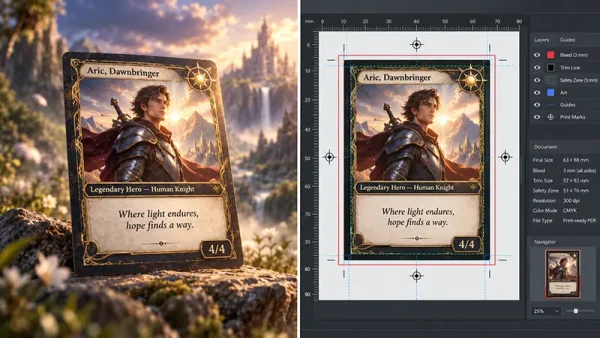
- Strict 3mm (0.118″) bleeds (artwork must extend fully to this line)
- Strict 2mm (0.078″) safe zones (all critical text must remain inside)
- The Business Benefit: This ensures every single card looks perfectly centered, eliminating costly mass-rejections from quality control and preventing negative unboxing reviews.
Mistake #4: Rasterizing Fine Text
Exporting rule text as standard 300 DPI raster images causes edge pixelation. When translating digital files to physical aluminum printing plates, the factory requirement is to keep all text and fine line art vectorized.
If rasterization is unavoidable, you must meet this standard:
- Absolute minimum resolution of 800 DPI (ideally 1200 DPI) for monochrome line art and text.
- The Business Benefit: This guarantees razor-sharp typography that enhances readability, protects your brand’s professional reputation, and prevents mass refunds from frustrated players.
Mistake #5: Submitting RGB Files to a CMYK Workflow
Digital screens emit light (RGB), while offset presses absorb light using ink (CMYK). Sending RGB digital art to an OEM facility forces an automated conversion that causes severe color shifts, particularly in vibrant blues and greens.
Files must be converted prior to submission:
- Industry-standard CMYK profiles (specifically Coated FOGRA39)
- The Business Benefit: This ensures your printed product perfectly matches your original digital vision, preventing disastrous color surprises on delivery day.
Quick Reference: Critical Prepress Tolerances
| Prepress Parameter | Factory Specification | Business Impact if Ignored |
|---|---|---|
| Color Profile | CMYK (Coated FOGRA39) | Unpredictable color shifting |
| Bleed Margin | 3mm (0.118″) minimum | White edges on trimmed cards |
| Text Resolution | Vector or 800+ DPI | Blurry, illegible rule text |
| Solid Black Build | C:60 M:40 Y:40 K:100 | Washed-out, cheap-looking backgrounds |

Retail-Ready Surface Finishes: Balancing Aesthetics with Manufacturing Realities
Surface coatings dictate the friction coefficient of the cards, which directly affects shuffling mechanics and long-term durability.
Factory Note: Never place foil stamping or thick Spot UV directly over the card edges or fold lines. The immense pressure of the steel-rule die-cutting blade will cause the foil to flake and chip, leaving jagged, unprofessional edges. Always engineer your specialty finish masks to stop at least 2mm away from any trim or crease line.
Mistake #6: Choosing the Wrong Coating for Shuffling Mechanics
Applying heavy glossy lamination increases the surface friction coefficient, causing cards to clump together—a fatal mechanical flaw for Trading Card Games (TCGs) or deck-builders.
For superior playability, specify these finishes:
- Linen Finish (creates micro-pockets of air between cards) or a specialized Matte UV coating.
- The Business Benefit: This provides a buttery-smooth shuffling experience that competitive players demand, driving positive word-of-mouth and repeat sales.
For a detailed breakdown of friction ratings and durability, explore our custom playing card surface finishes.
Mistake #7: Misaligned Spot UV and Foil Masks in Prepress
Spot UV and Cold/Hot Foil stamping require dedicated aluminum plates or screens. Any pixelation or misalignment between the CMYK artwork layer and the foil mask layer will result in severe registration errors.
The prepress guidelines dictate:
- Mathematically perfect vector mask files set to 100% K (Black).
- The Business Benefit: This ensures a flawless, high-end tactile feel that makes your collector’s editions truly worth their premium price tag.

Packaging & Fulfillment: Downstream Structural Failures That Hurt Your Brand
The structural integrity of your packaging must survive the rigors of global logistics, warehousing, and retail display.
Factory Note: Standard shrink wrap continues to contract under varying warehouse temperatures. If your tuck box uses a lightweight 300gsm board and the deck inside is packed loosely, the shrink wrap tension will warp the box into a ‘U’ shape over time. For high-end decks, we highly recommend cello-wrapping with a tear tape to prevent this structural distortion.
Mistake #8: Under-Engineering the Tuck Box
Tuck boxes must withstand pallet stacking and international transit. Utilizing standard cardstock for exterior packaging leads to crushed inventory.
The baseline engineering standards are:
- 350gsm C1S (Coated One Side) paperboard for standard retail tuck boxes.
- 400gsm C1S for heavier decks (78+ cards).
- The Business Benefit: This dramatically reduces transit damage and ensures your product looks pristine on retail shelves, lowering your return rates and protecting your profit margins.
Mistake #9: Forgetting Retail Barcode Clearances and Shrink-Wrap Tension
Retail distribution requires scannable UPC/EAN barcodes. Additionally, improper shrink-wrap tension applied during final assembly can warp or crush poorly designed tuck boxes.
Prepress files and box geometry must include:
- A clear, unvarnished zone (no Spot UV or Foil) over the barcode area to prevent scanner reflection.
- The Business Benefit: This guarantees frictionless retail distribution and prevents your inventory from being rejected by major big-box distributors.
Mistake #10: Skipping the Physical Hard Proof
Digital PDF proofs cannot verify paper texture, card snap, friction coefficients, or exact color matching under physical lighting. Authorizing a $10,000+ manufacturing run based solely on digital files is a massive financial risk.
Professional procurement protocols mandate:
- Reviewing a physical hard proof (or wet proof) before greenlighting mass production.
- The Business Benefit: This gives you absolute peace of mind and final sign-off power before committing your entire Kickstarter budget.
Why Indie Publishers & Kickstarter Creators Partner With Our OEM Facility
Executing a flawless 500+ MOQ wholesale order requires industrial-grade infrastructure and stringent quality control protocols.
Factory Note: Many creators panic when they receive their first physical proof because it looks slightly darker than their backlit LED monitor. Trust the physical proof. Monitors emit light, while printed paper absorbs it. Always evaluate your wet proofs under standard 5000K daylight bulbs to see the true retail color.
- Factory Capability: Our facility operates state-of-the-art Heidelberg Speedmaster offset presses and automated optical die-cutting systems.
- The Business Benefit: This ensures exact color fidelity, sub-millimeter cutting precision, and rapid turnaround times for your global fulfillment.
- Sustainability (FSC Certification): We maintain strict Forest Stewardship Council (FSC) certification, guaranteeing that all paper substrates are ethically sourced.
- The Business Benefit: This meets the stringent eco-friendly requirements of modern Kickstarter campaigns, giving you a powerful marketing angle for environmentally conscious backers.
- Proven Case Study: Recently, we partnered with a Kickstarter creator to scale their project to a 10,000-deck global fulfillment run. During our standard prepress audit, our technicians identified a critical RGB-to-CMYK conversion error in the core artwork. By catching this before plate creation, we saved the publisher over $15,000 in potential misprints and kept their global delivery timeline perfectly on schedule.
Ready to Manufacture Your Custom Card Game?
Securing your manufacturing pipeline early is critical to a successful product launch. Do not let preventable prepress errors derail your budget or your fulfillment timeline.
- Download our free OEM prepress templates today to ensure your files meet factory specifications.
- Or, contact our manufacturing specialists for a comprehensive technical audit and a custom quote on your next bulk order.