Author’s Note by Alex Dong, Chief Technical Consultant: I’ve spent over four decades on the factory floor, and if there’s one lesson that never changes, it’s this: coating doesn’t fail randomly — it fails predictably, once you know what to look for. Flashcards get flipped thousands of times a semester, far more punishing than any deck of cards I’ve tested. Before you choose a finish, here’s what actually determines whether it survives that kind of use.
Unlike trading card manufacturers, who prioritize back-pattern consistency to prevent marking during shuffling, flashcard buyers are solving a different engineering problem: surface durability under repeated, one-directional flipping.
A trading card gets shuffled a few hundred times over its lifespan. A classroom flashcard set gets flipped thousands of times in a single semester.
That difference changes which coating actually makes sense for your production run.

Matte / Glossy / Soft-touch Corner Texture
Coating Is Your Second Line of Defense — Right After Cardstock Weight
Once you’ve locked in the right paper weight using the framework in our cardstock weight selection guide, coating becomes the second variable standing between your flashcard set and premature wear.
Weight determines how much the card resists bending and cracking. Coating determines how the surface holds up against skin contact, friction, and repeated handling — a separate failure mode entirely.
Quick Reference: All coating options below are available starting at MOQ 200 units per SKU, with full support from prototype validation through large-scale production.
Custom branding and private label packaging are supported at no additional MOQ tier — see the ordering details near the end of this article for specifics.
Key Takeaways
- Cardstock weight and coating solve two different problems: weight resists structural bending, coating resists surface wear.
- Both variables need to be selected together, not in isolation, to match your actual usage frequency.
- All coating options are available starting at MOQ 200 units per SKU, with full support from prototype through full-scale production.
Coating vs. Lamination: Which Manufacturing Process Actually Determines Your Flashcard’s Failure Point?
Most sourcing conversations treat “matte,” “glossy,” and “soft-touch lamination” as interchangeable finish options on a single dropdown menu.
In production, they are not the same process, and that distinction matters once a print run scales into the thousands — the kind of volume where a single coating defect gets multiplied across an entire batch instead of showing up on just a handful of cards.
Key Takeaways
- Glossy and some matte finishes are applied as a liquid UV coating, cured directly onto the printed surface.
- Matte and soft-touch finishes are more commonly achieved through lamination — a plastic film bonded to the card under heat and pressure.
- These two processes fail differently under stress: UV coating tends to crack or dull on the surface, while lamination tends to lift or delaminate at the edges.
- Knowing which process produced your finish tells you which failure mode to watch for during quality control.
How Coating Fails: Surface-Level Wear
UV coating is a thin resin layer cured with ultraviolet light directly onto the ink surface.
It bonds well to coated stock but has limited flexibility — under repeated flexing (the exact motion of flipping a flashcard), microscopic surface cracks can appear over time, leading to dulling or fine scratching.
Glossy UV coating typically shows this first, since its reflective surface makes minor imperfections more visible.
How Lamination Fails: Edge and Bond Integrity
Lamination film is bonded under heat and pressure, which means its failure point is different: rather than cracking on the surface, laminated cards are more prone to edge lifting or delamination.
This happens if the bonding temperature or dwell time was slightly off during production — a defect that shows up disproportionately on high-flip-frequency products because the edges take the most repeated stress.
Factory Note: Nine times out of ten, when a customer sends back a batch complaining about lamination “peeling at the corners,” the root cause traces back to laminator roller temperature drifting during a long run — not a defective film.
Humid factory environments make this worse, since ambient moisture affects how well the adhesive layer activates under heat. If you’re sourcing overseas, ask your factory whether they recalibrate roller temperature checks per shift, not just per job — that single habit is often the difference between a clean batch and a return shipment.

UV Coating vs Lamination
A Note on Child Safety Compliance
If your flashcard program targets younger learners — particularly K-5 classrooms or early literacy programs — coating and lamination materials should be evaluated against relevant child product safety standards, not just wear resistance.
In the U.S. market, this typically means confirming CPSIA compliance (covering lead content and phthalate limits in inks, adhesives, and coatings); in EU markets, EN71 toy safety standards may apply depending on how the product is classified.
Request current compliance documentation and third-party test reports directly from your manufacturer before finalizing a coating choice for early-childhood or K-5 programs — compliance status can vary by ink formulation and lamination adhesive supplier, even within the same coating category.
Matte vs. Glossy vs. Soft-Touch Lamination: Which Finish Actually Survives Repeated Flashcard Flipping?
Key Takeaways
- Matte generally outlasts glossy under repeated flipping, but shows white edge-scuffing faster on dark-colored designs.
- Soft-touch offers the softest tactile feel but absorbs oils from skin contact faster than the other two options.
- No single finish “wins” universally — the right choice depends on flip frequency, design color palette, and how the cards will be handled.
Test Methodology
Wear resistance testing for flashcard coatings typically follows a mechanical flip-simulation protocol:
- Cycle count: There’s no universal “flip test” standard written specifically for flashcards, but the closest industry analog is the Sutherland Rub Test (ASTM D5264), commonly used in packaging and commercial print to evaluate coating abrasion resistance, typically run across a 20–100 rub-cycle range (industry-standard range — confirm exact specs with your supplier before production). Rub motion and flip motion aren’t mechanically identical, so treat this as a useful reference point rather than a direct substitute.
- Evaluation checkpoints: assessed at regular intervals — commonly every 250–500 simulated flip cycles (industry-standard range — confirm exact specs with your supplier before production) — for surface scuffing, edge whitening, print rub-off, and corner delamination onset.
- Environmental controls: testing should ideally be conducted at controlled humidity (typically 45–55% RH), since ambient moisture affects both UV coating flexibility and lamination bond strength.
Comparative Wear Resistance Reference
Glossy (UV Coating)
- Estimated wear cycle range: 500–1,500 flips before visible surface scratching (industry-standard range — confirm exact specs with your supplier before production)
- Primary failure mode: Surface scratching, fingerprint smudging
Matte (UV Coating or Lamination)
- Estimated wear cycle range: 1,500–3,000 flips before edge whitening onset (industry-standard range — confirm exact specs with your supplier before production)
- Primary failure mode: Edge whitening, corner scuffing under friction
Soft-Touch (Lamination)
- Estimated wear cycle range: 1,000–2,500 flips before visible oil buildup (industry-standard range — confirm exact specs with your supplier before production)
- Primary failure mode: Oil/fingerprint absorption, texture flattening
These ranges reflect general industry patterns in coating and lamination durability testing, not verified lab results for this specific product line. Request a sample pack for side-by-side wear testing under your actual flashcard use conditions.
A Note on Dark-Colored Flashcard Designs
If your flashcard set uses large dark-colored backgrounds — common in color-coded subject categories or advanced-difficulty tiers — standard matte lamination will show visible white scratch marks significantly faster than on lighter designs.
For any design with substantial dark coverage, request anti-scratch matte lamination specifically, rather than the standard-grade film, to offset this accelerated wear pattern.
Factory Note: Here’s a defect most buyers never think to check for: after laminated sheets go through die-cutting, the trim blade can leave a microscopically rough edge where the film doesn’t fully seal to the raw paper core. Under a fingernail, that’s the starting point for peeling — and it’s completely invisible until a customer has handled the card a few dozen times.
Ask your factory whether their die-cutting blades are inspected for sharpness on a fixed schedule, not just replaced when someone notices a problem. Dull blades on laminated stock are one of the most common — and most preventable — sources of field complaints.

Scratched Dark Matte Corner Vs Anti-Scratch Matte Sample
Low, Medium, or High-Frequency Use: Which Coating Threshold Fits Your Flashcard Program?
Key Takeaways
- Low-frequency use (occasional home study) doesn’t justify the extra cost of matte or soft-touch — glossy performs fine.
- Medium-frequency use (weekly classroom rotation) is where matte starts to outperform glossy on cost-per-use.
- High-frequency use (daily drilling, tutoring centers) is where soft-touch or anti-scratch matte earns back its premium.
Following the frequency tiers established in our cardstock weight selection guide, coating selection should shift once your flashcard program crosses these usage thresholds.
These frequency bands are based on general spaced-repetition learning conventions common in educational settings, rather than manufacturer-tested data — actual usage will vary by classroom structure and study habits:
- Tier 1 — Low Frequency (roughly 5–15 flips/week per card — general usage estimate, not a lab-tested figure): Glossy remains the practical default. Wear risk is minimal, and the cost savings versus matte or soft-touch are difficult to justify at this volume. This tier typically covers occasional home study sets or supplementary reference decks.
- Tier 2 — Medium Frequency (roughly 15–40 flips/week per card — general usage estimate, not a lab-tested figure): Matte becomes the practical threshold. This is typically where weekly classroom review sessions or homeschool curriculum sets land.
- Tier 3 — High Frequency (roughly 40–100+ flips/week per card — general usage estimate, not a lab-tested figure): Soft-touch lamination or anti-scratch matte should be evaluated, particularly for daily vocabulary drilling at language learning centers or intensive tutoring programs where the same deck sees repeated use every session.
For high-volume classroom or language school orders, durability requirements at this tier often mirror what we’ve documented in our K-12 flashcard bulk order case studies — worth reviewing before finalizing your coating specification.
Factory Note: Something worth knowing before you split an order across multiple coating types: switching from matte to soft-touch mid-production isn’t just a settings change — it usually means a full production line cleaning and film changeover, which adds both time and setup cost that a lot of factories don’t itemize clearly on quotes.
If your program needs multiple coating tiers (say, a glossy version for retail and a soft-touch version for premium bundles), ask upfront whether your factory batches those runs separately or on the same line — mixing SKUs with different coatings on one production floor is also a common source of shipping mix-ups if the packing team isn’t careful.
Matte, Glossy, or Soft-Touch Lamination: What’s the Real Cost Premium for Each Coating Option?
Key Takeaways
- Glossy is the cost baseline; matte adds roughly 10–15%; soft-touch adds roughly 20–30%.
- Soft-touch costs more mainly due to slower production line speed, not just material cost.
- Standard MOQ is 200 units per SKU regardless of coating, but soft-touch carries a longer lead time.
Coating Cost Premium Reference
Glossy (UV Coating) — Baseline
Matte (UV Coating or Lamination) — +10%–15% (industry-standard range — confirm exact specs with your supplier before production)
Soft-Touch (Lamination) — +20%–30% (industry-standard range — confirm exact specs with your supplier before production)
Actual markup varies by print run volume and substrate combination. Confirm current pricing tiers directly with your manufacturing partner before finalizing your budget.
Factory Note: The reason soft-touch lamination costs more isn’t just the raw film — it’s throughput. Soft-touch film has a slightly tackier surface than standard matte or gloss laminate, which means the laminator has to run slower to avoid trapping air bubbles under the film.
Slower line speed means fewer sheets per hour, which factories pass along as a per-unit premium. It’s also a less commonly stocked film compared to standard matte or gloss, so smaller factories sometimes have to order it in specifically for your job, adding lead time on top of cost.
A Note on Minimum Order Quantity and Lead Time
Our standard MOQ for flashcard production is 200 units per SKU, regardless of coating type — this applies whether you’re ordering a single design or a mixed-coating batch across a product line.
That said, soft-touch lamination still carries a longer production lead time than glossy or standard matte, since the slower laminator speed described above affects turnaround even at low order volumes. If your program needs a fast initial batch, glossy or standard matte will typically ship sooner than a soft-touch run of the same quantity.
We also support the full range from prototype to full production scale — you can order a small proto batch at MOQ to validate coating, color, and card feel before committing to a larger run, then scale up on the same specification once approved.
This is worth using if you’re testing a new design or entering a new coating tier for the first time, rather than committing directly to a large batch on an unverified spec.
A Note on Getting an Accurate Quote
Final pricing depends on the specific combination of material, coating process, surface treatment, and packaging you select — rather than order quantity alone.
Two orders of the same size can carry different unit costs depending on whether you choose glossy UV coating or soft-touch lamination, standard cardstock or a heavier weight, or bulk packing versus custom retail boxes.
For this reason, we quote each order individually based on your final specification rather than publishing a fixed price list — reach out with your target coating, material, and packaging preferences for an accurate quote.
A Note on File Preparation Costs
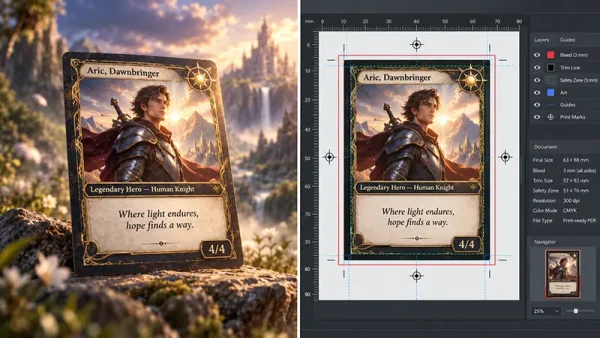
Regardless of coating choice, your print files should be submitted in CMYK color mode with a 3mm (0.125″) bleed margin — files submitted in RGB or without proper bleed typically require rework, which can add unplanned turnaround time to your production schedule.
If your flashcard design includes a school or brand logo color, or a curriculum design file that gets reordered across semesters, request a CMYK or Pantone spot color proof at the design stage rather than relying on your screen’s RGB display. This prevents batch color variance between your first production run and any future reorders.

Is Soft-Touch Lamination’s Extra Cost Worth It for High-Volume Flashcard Orders?
Key Takeaways
- Soft-touch pays off best for lower-rotation use — gift sets, occasional home study, premium retail bundles.
- Matte generally delivers better cost-per-use ROI for daily, high-repetition classroom or tutoring use.
- Soft-touch’s texture also serves a functional purpose for sensory-sensitive learners, not just aesthetics.
When Soft-Touch Lamination’s Premium Pays Off
Soft-touch delivers a distinctive tactile finish that performs well for lower-rotation use cases — occasional home study sets, gift-style educational products, or supplementary reference decks that get pulled out weekly rather than daily.
In these contexts, the oil-absorption drawback has less time to accumulate visibly before the set is due for retirement anyway.
A Note on Sensory-Friendly Applications
Beyond general durability, soft-touch’s distinct tactile texture has a niche but genuine use case worth flagging: some special education programs specifically request matte or soft-touch finishes over high-gloss coatings for students with sensory processing sensitivities, where a glossy, high-reflectivity surface can be visually overstimulating or texturally aversive.
If your flashcard program serves special education classrooms or sensory-sensitive learners, it’s worth discussing texture preferences with the receiving educators directly — this is a case where the “premium” tactile finish may solve a functional need rather than just an aesthetic one.
When Matte Delivers Better ROI
For structured, high-repetition use — daily vocabulary drilling, weekly classroom rotation, tutoring center review sessions — the cost-per-use math generally favors matte.
Its lower price point combined with predictable, gradual wear (rather than soft-touch’s faster oil buildup) tends to produce a longer usable lifespan per dollar spent at this usage tier.
Factory Note: Here’s something that catches buyers off guard during quality inspection: soft-touch film can pick up visible handling marks during warehousing and shipping — before the product even reaches the end customer. In humid climates especially, warm hands during packing can leave faint oily marks that show up under certain lighting.
If you’re ordering soft-touch lamination for a humid-climate market, ask your factory about their glove policy on the packing line — it’s a small detail that matters more than most buyers expect.

A Note on Custom Branding and Packaging
Coating choice also affects how well your logo or brand elements print onto the card surface — matte finishes generally show fine-line logo detail more clearly than glossy, while soft-touch lamination can slightly soften sharp edges on small text or fine print.
If your program requires custom branded packaging, private label boxes, or specific logo placement alongside your coating specification, raise this during your initial quote request — it affects both production sequencing and final unit cost.
We support full private label and custom packaging on all coating types, from single-SKU proto runs through full production scale — there’s no separate MOQ tier for customization beyond the standard 200-unit minimum.
Ready to See the Difference Before You Commit?
Explore our custom flashcard manufacturing services to discuss coating specifications for your next classroom or curriculum production run, or request a coating comparison sample pack to feel the wear difference firsthand.
Keep in mind that a digital proof and a physical press sample can show a noticeable color and finish difference — this is a normal part of the offset printing process, not a defect.
Confirming your coating choice against a physical sample, rather than a screen mockup, gives you a much more accurate read on how the finish will actually feel and wear in daily use.
Request a Flashcard Coating Comparison Sample Pack
Get a production quote directly — starting at MOQ 200 with full private label and custom packaging support, from prototype through full-scale production.