Alex Deng | Production Manager
“Over my 12 years managing the production floor, I’ve seen firsthand how a brilliant card game can be ruined by a single packaging oversight—whether it’s an invisible moisture leak in a foil booster or lacquer bubbling on a custom tin. You spend months perfecting your cards, but the packaging is what actually protects that investment. Let me share some critical factory-level insights to help you avoid these costly mistakes.”
When you are launching a Trading Card Game (TCG), a deluxe Kickstarter tier, or a premium tarot deck, standard paperboard packaging simply isn’t enough. Your packaging needs to protect against humidity, signal premium quality on the retail shelf, and create a highly tactile unboxing experience.
Below is a technical deep dive into the specifications for premium rigid boxes, metal tins, and TCG foil boosters — and the hidden manufacturing risks associated with each.
Premium Paperboard Formats

Magnetic Flip Box and Magnetic Book Box
The magnetic flip box is a two-piece rigid construction consisting of a base tray and a hinged lid, held closed by embedded neodymium magnets. The exterior is wrapped in printed paper laminated over a greyboard substrate.
- Key specs: Greyboard weight is 1,500 gsm (standard retail) or 2,000 gsm (premium retail and transit-stressed applications). Magnets are N35 grade neodymium, 10mm diameter × 3mm depth. Magnet placement tolerance is ±1.5mm.
- What this means for you: The magnetic flip box is the single most effective packaging upgrade for Kickstarter deluxe tiers. Backers who receive a magnetic flip box consistently report higher unboxing satisfaction — translating directly into social media posts and word-of-mouth. The unit cost premium is approximately 3–5× over a tuck box at 500 units, but the conversion lift justifies the cost.

Lid and Bottom Box, Lux Box, and Drawer Box
- Lid and Bottom Box: A two-piece rigid box (1,200–1,500 gsm greyboard) where the lid telescopes over the base. This format signals product quality before the box is even opened, perfect for specialty gift retailers.
- Lux Box: A two-piece rigid construction with a snug-fit lid that sits flush with the base walls (±0.5mm tolerance). This is the dominant format for tarot and oracle card decks. The snug-fit closure creates a tactile “pop” when opened that buyers associate with premium quality.
- Drawer Box: Consists of an outer sleeve and an inner tray that slides out horizontally. The sliding drawer mechanism is the unboxing interaction most frequently shared on social media.
Lux Box and Drawstring Pouch Combination
For tarot, oracle, and collector card products targeting specialty retail, combining a lux box with a drawstring pouch (velvet, cotton muslin, or satin) serves a dual function. It protects card edges from abrasion during transit and becomes a keep-able accessory. This combination commands a retail price premium of approximately 20–35%.
⚠️ Factory Note: Soft-touch lamination on lux boxes and rigid boxes is the finish most frequently flagged for quality rejection during our pre-shipment inspection — not because of print issues, but because of fingerprint and handling marks accumulated during the hand-wrapping process. Soft-touch coating has an extremely low surface energy, which means it attracts and retains oils from bare-hand contact. We run all soft-touch rigid box production with cotton glove protocols, but any box that will be handled extensively during fulfillment should be individually bagged in a polybag with a silica gel desiccant.
TCG / Trading Card Game Formats
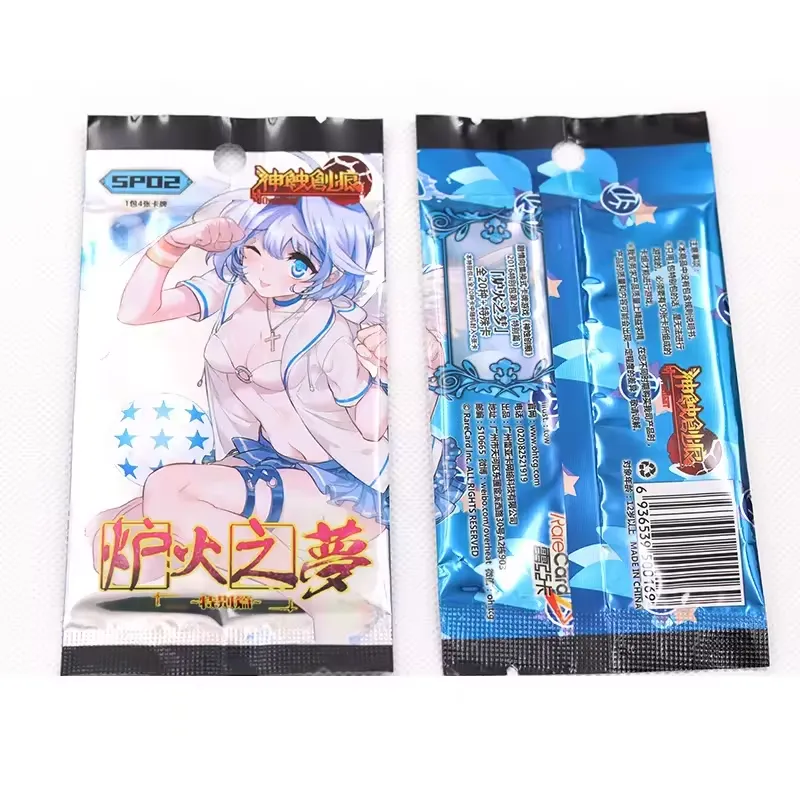
Custom Booster Packs: Foil Pouch vs. Paper Pack
The foil booster pack is the standard packaging format for collectible and trading card games. It consists of a heat-sealed flexible pouch constructed from a multi-layer laminate (Outer BOPP/PET, Barrier Aluminum foil, Inner Heat-seal polyethylene). Total thickness is 80–120 microns.
| Format | Moisture Barrier | Print Method | Typical Card Count | Channel Fit |
|---|---|---|---|---|
| Foil Booster Pack | ✅ High (aluminum barrier) | Rotogravure / Flexo | 5–15 cards | Hobby retail, TCG distribution |
| Paper Sleeve Box | ❌ None | Offset lithography | Up to 18 cards | E-commerce, Kickstarter |
What this means for you: The aluminum barrier layer is not a premium option — it’s the specification that protects your cards from humidity damage in transit through Southeast Asian ports, in warehouse storage, and on retail shelves. A foil pack with an MVTR (Moisture Vapor Transmission Rate) of < 0.5 g/m²/day keeps your cards in mint condition.
⚠️ Factory Note: The most common structural failure we see in foil booster pack production is the “channel effect” — a narrow unsealed channel caused by a wrinkle in the laminate film as it feeds through the heat-seal jaws. Invisible to the naked eye, it creates a direct moisture pathway. We catch this with a pressurized air leak test (15 kPa for 10 seconds submerged in water) on a statistical sample of every run. If your manufacturer does not perform a leak test protocol, your cards are at risk.

Booster Pack Display Box
A counter-display or shelf-display outer carton designed to hold individual booster packs.
- Configurations: 12-pack (compact counter display), 24-pack (standard shelf display), 36-pack (large dedicated shelf).
- What this means for you: Major North American hobby distributors typically require a minimum 24-pack display box configuration as a condition of stocking a new TCG product. Spec it alongside your booster pack, not as an afterthought.
Metal and Specialty Material Formats

Tin Box, Aluminum Box, and Mint Tin
Metal packaging uses tinplate steel or aluminum, printed via lithographic offset printing directly onto the metal sheet. A white base coat is required, otherwise ink colors appear muted.
- Mint Tin: Standard finished dimensions are 97mm × 62mm × 19mm (holds 30-40 cards). At a retail price point of $10–$15, a well-designed mint tin sells itself at checkout counters and convention tables.
⚠️ Factory Note: Tin box production has one yield risk almost no client anticipates: lacquer adhesion failure on dark-field designs. When a tin box has a large area of deep, saturated color, the ink layer is thicker. If the post-print lacquer coat is applied before the ink has fully cured, it traps residual solvent, causing microscopic bubbling and peeling. We enforce a minimum 24-hour ink cure window before lacquer application on all dark-field tin jobs to eliminate this failure mode.

Custom Playing Card Case (Plastic Clamshell)
Injection-molded from 0.5–0.8mm PET sheet (clear) or frosted polypropylene. Plastic surfaces cannot be directly offset-printed — customization requires a printed paper insert card or sleeve. This is the only format that lets the card art sell itself with zero packaging obstruction.
💡 Frequently Asked Questions (Premium Packaging)
Q: Can I do foil stamping on a foil booster pack? No. Foil booster packs are printed on flexible film using rotogravure or flexographic presses. Traditional hot foil stamping requires a rigid substrate (like paperboard). To achieve metallic effects on a booster pack, we use the natural metallic sheen of the aluminum barrier layer and print translucent inks over it.
Q: What is the minimum order quantity (MOQ) for custom tin boxes? Because metal forming requires dedicated tooling and specialized lithographic presses, the MOQ for custom-printed tin boxes is typically higher than paperboard, often starting at 1,000 to 2,500 units depending on the factory’s tooling inventory.
Next Steps: Engineer Your Premium Unboxing
Ready to elevate your game’s perceived value? Don’t guess on greyboard weights or magnet alignments.
👉 [Book a 20-minute technical consultation with our packaging engineers to discuss your premium format.]