Author’s Note | Wensong Li, Prepress Design Director Over my 9 years in print and packaging design, I’ve seen countless beautiful concepts fail on the press simply due to mixed color builds or incorrect bleed margins. As Prepress Design Director, my goal is to bridge the gap between your creative vision and our factory floor. In this guide, I’m sharing the exact structural specifications and color management protocols you need to master so your next bulk production run prints flawlessly.
Beautiful artwork means nothing if it doesn’t translate accurately to the physical box. When publishers transition from print-on-demand prototypes to bulk manufacturing, they often discover a harsh reality: industrial printing is a game of microscopic tolerances.

The specifications in this guide are the pre-press and structural parameters that determine whether your packaging runs cleanly on production equipment, holds its structural integrity through fulfillment, and meets the color accuracy standards required for retail placement.
⚠️ Factory Note: There is a specific pre-press error we see repeatedly from clients who have worked with multiple manufacturers: mixed spot color and process color builds for the same visual element across different files. A client will have their logo built as Pantone 485 C in the tuck box file, and as a CMYK build (C:0 M:100 Y:100 K:0) in the booster pack file. On press, Pantone 485 C and a CMYK red build will never match, even on the same press on the same day. Before submitting any multi-SKU order, do a global audit in Illustrator and confirm that every color used is either consistently a named Pantone swatch or consistently a CMYK build.
Board Weight by Box Format: The Complete Selection Guide
Board weight is not a cost variable to optimize downward. It is a structural specification that determines whether your boxes survive automated fulfillment, transit, and retail handling. Specifying the wrong board weight to save $0.02 per unit can cost you an entire reprint run.

| Box Format | Recommended Board Weight | Production Line Compatibility | Structural Rating |
| Standard Tuck Box | 350 gsm SBS | ✅ Full auto-insertion line | ★★★☆☆ |
| Magnetic Flip Box | 1,200–2,000 gsm greyboard | ⚠️ Semi-automated wrapping line | ★★★★★ |
| Lux Box / Rigid Box | 400 gsm SBS + greyboard | ⚠️ Hand-wrapped | ★★★★★ |
| Booster Pack (paper) | 130–157 gsm art paper | ✅ Heat-seal line compatible | ★★☆☆☆ |
| Brick Box | B-flute corrugated, 3mm wall | ✅ Standard carton line | ★★★★☆ |
Color Management: Holding ΔE < 2.0 on Press
Visual inspection alone is not a reliable QC method for color-critical work. Color accuracy on packaging is measured using a spectrophotometer — an instrument that measures the spectral reflectance of a printed color and calculates its ΔE (Delta E) deviation from the target Pantone or CMYK value.
ΔE (Delta E) Color Difference Standards:
- ΔE < 1.0: Imperceptible to the human eye (Laboratory standard)
- ΔE 1.0–2.0: Perceptible only under close inspection (✅ Commercial print acceptable)
- ΔE 2.0–3.5: Noticeable to a trained observer (⚠️ Borderline — review required)
- ΔE > 3.5: Clearly visible color difference (❌ Reject — reprint required)
Our Factory QC Protocol:
- Press calibration: Profiled to ISO 12647-2:2013 at the start of each shift.
- Draw-down proof: Pulled and measured against the target Pantone value before the run begins.
- In-line measurement: Press sheets pulled and measured at every 500-sheet interval using an inline spectrophotometer.
- Acceptance threshold: We hold a strict ΔE < 2.0 on all Pantone-matched colors. This is the threshold at which color variation becomes invisible to a non-specialist observer under normal retail lighting.

Dieline Templates and Safe Zones Recap
To prevent full-run reprints, your files must adhere to three strict rules:
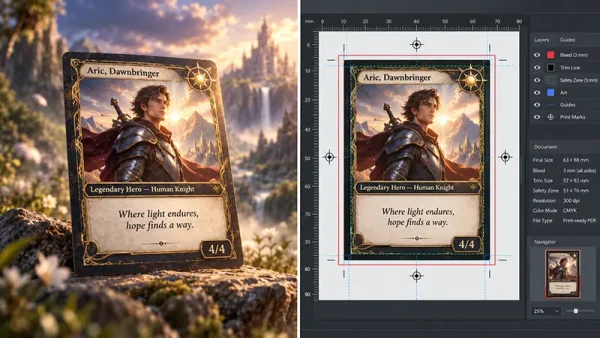
- Bleed: 3mm on all sides of every panel.
- Safe Zone: 5mm minimum from the trim line for all critical elements.
- Glue Flap Dead Zone: 8mm from the fold score line, entirely free of ink coverage.
What to request from your manufacturer before design begins: Always request a factory-issued dieline. For a Tuck Box, confirm the finished L × W × H, card count, and card stock caliper. For a Magnetic Flip Box, confirm the magnet position and greyboard caliper. A factory-issued dieline is free and eliminates the single most common cause of structural failure.
Factory Capabilities That Matter at Scale
Certifications for North American Retail
- FSC Certification: Verifies that paper and board originate from responsibly managed forests. This is increasingly a buyer requirement for chains like Target and Barnes & Noble.
- CPSIA Compliance: Regulates chemical content for children’s products (ASTM F963, Lead content limit of 100 ppm). This is a legal requirement for sale in the US.
- California Prop 65: All our UV-curable coatings and inks are formulated to comply with current Prop 65 listed substance thresholds.
The Vertical Integration Advantage When die-cutting, lamination, and specialty finishing are performed by separate subcontractors, each handoff introduces scheduling latency and quality inspection overhead. Our vertically integrated facility performs offset printing, die-cutting, lamination, foil stamping, embossing, and automated gluing under one roof. Eliminating subcontractor handoffs reduces total production lead time by 25–30% on average.
Frequently Asked Questions (QC & Specs)
Q: Should I use Pantone Coated (C) or Uncoated (U) swatches? It depends on your final surface finish. If your box will have gloss lamination or spot UV, use Pantone Solid Coated (C suffix). If your box will have matte lamination or soft-touch lamination, use Pantone Solid Uncoated (U suffix). Never mix C and U swatches within the same file.
Q: What is SBS board? SBS stands for Solid Bleached Sulfate. It is a premium paperboard grade made from bleached virgin wood pulp. It offers a superior white surface for vibrant offset printing and excellent structural rigidity for folding cartons like tuck boxes.
Next Steps: Audit Your Files
Don’t wait until your files are on the press to find out your colors are out of gamut or your bleed is insufficient.