I’ve spent over four decades in printing standardization and quality management, and if there’s one claim that causes the costliest disputes, it’s the word “waterproof.” Too many buyers assume standard lamination guarantees full protection — until a field return proves otherwise. My role is verifying that a product’s actual construction matches the claim on its packaging. Here’s what you need to confirm before you approve that word for your next production run.
— Alex Dong, Chief Technical Consultant
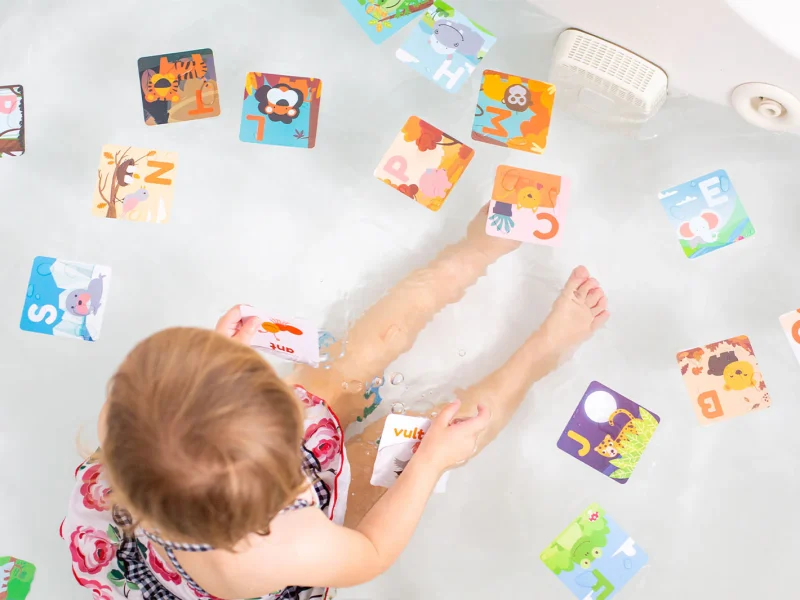
“Waterproof” is one of the most requested — and most misunderstood — specs in bulk flashcard production. Before comparing finish options, it’s worth asking a more useful question than “which one is more waterproof?” The better question is: what moisture exposure does this product actually need to survive, and for how long?
A preschool deck used at home, a language-learning set that stays in classroom circulation for years, and a travel or outdoor learning kit each carry a different real-world risk profile — and each one justifies a different construction. This guide breaks down the technical difference between water-resistant and waterproof flashcards, where the “laminated equals waterproof” assumption breaks down, and how to match your spec to your actual use case without overpaying for protection nobody will ever test.
This guide is written for B2B buyers planning custom flashcard production in quantities of 200+ sets — educational publishers, children’s product brands, training companies, and learning kit developers.
Waterproof vs. Water-Resistant Flashcards: What’s the Real Difference?
Quick Summary: Water-resistant flashcards use a surface coating or standard film lamination over a paper core, which repels spills and light moisture but leaves the paper core absorbent underneath. Waterproof flashcards require either a fully synthetic substrate or a completely edge-sealed lamination process with no exposed paper fiber. This is a structural manufacturing decision, not a marketing label — and it changes your unit cost by a measurable margin.
Water-Resistant — Surface Protection Over a Paper Core
Water-resistant flashcards typically start with standard paper stock — most commonly in the 300gsm–350gsm range — and add a protective layer on top:
- Matte or gloss varnish coating — the most economical option, applied as a liquid coating during printing
- Standard two-side film lamination (no edge seal) — adds surface durability and a premium hand-feel, but the cut edge still exposes raw paper. This is what we’d classify as the upper end of water-resistant, sometimes called “semi-waterproof” — it holds up well to daily handling but is not built for sustained moisture exposure.
This layer blocks incidental moisture — coffee spills, humid air, sweaty classroom hands — but the paper core underneath remains absorbent.
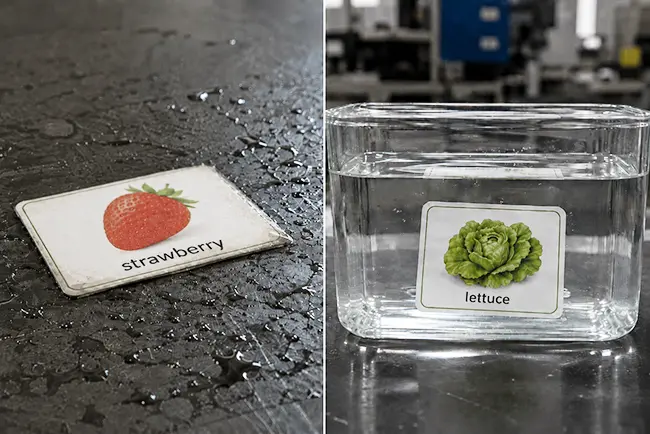
Waterproof — Full Encapsulation or a Synthetic Substrate
True waterproofing requires one of two structural approaches, both landing at the same top protection tier:
- Synthetic substrate (PP, PVC, or PET-based) — no absorbent fiber at all, regardless of how the card is cut
- Edge-sealed lamination — standard film lamination upgraded with a sealing process so the film fully encloses the card rather than stopping at the trim edge
Factory Note: A surprising number of quote requests specify “waterproof lamination” but only budget for standard two-side film lamination. Two-side lamination without edge-sealing is water-resistant at best. If waterproof performance is a hard requirement, say so explicitly and ask us to confirm the edge-treatment method in writing — not just the word “laminated.”
The Hidden Gap: Why “Laminated” Doesn’t Always Mean “Waterproof”
Quick Summary: Most flashcard water damage doesn’t happen through the front or back surface — it happens through the exposed edge. Standard lamination protects the flat faces of a card but leaves the paper core visible at the cut line, giving moisture a direct entry point. This single detail explains most post-production complaints about “laminated” cards failing in wet conditions.
The Edge-Sealing Problem Nobody Mentions
When a card is laminated and then die-cut, corner-rounded, or guillotine-cut to size, the lamination film is sliced along with the paper underneath. The result:
- Front and back faces stay fully protected
- The cut edge exposes raw paper fiber
- Moisture wicks inward from that edge over time — even while the surface stays visibly dry
This is why cards marketed as “laminated” can still warp, delaminate, or soften after prolonged humidity exposure. The damage starts invisibly at the border and works inward.
Substrate Comparison
| Construction | Moisture Protection | Edge Vulnerability | Relative Cost | Best Use Case |
|---|---|---|---|---|
| Standard paper + lamination (no edge seal) | Good surface, weak edge | High | Lower | Classroom, retail, light handling |
| Standard paper + edge-sealed lamination | Full-body protection | Low | Medium–High | Frequent handling, moderate-to-high moisture exposure |
| Synthetic substrate (PP/PET/PVC) | Strong, full-body, non-porous | None | Higher | Washable, outdoor, high-humidity use |
Factory Note: Rounded corners and die-cut shapes are common for children’s products because they improve safety and comfort — but every additional cut creates more exposed edge area. Cards with unusual shapes, tabs, or small die-cut profiles carry more edge risk than standard rectangular cards, and should be sample-tested using the final cutting method before mass production.
Matching Protection Level to Your Product
Quick Summary: Most flashcard brands should choose protection based on actual use, not by defaulting to the highest available spec. Preschool products often need stronger spill/handling resistance; language-learning products benefit more from long-term surface durability than maximum waterproofing; travel and outdoor products are where the upgrade genuinely pays off.
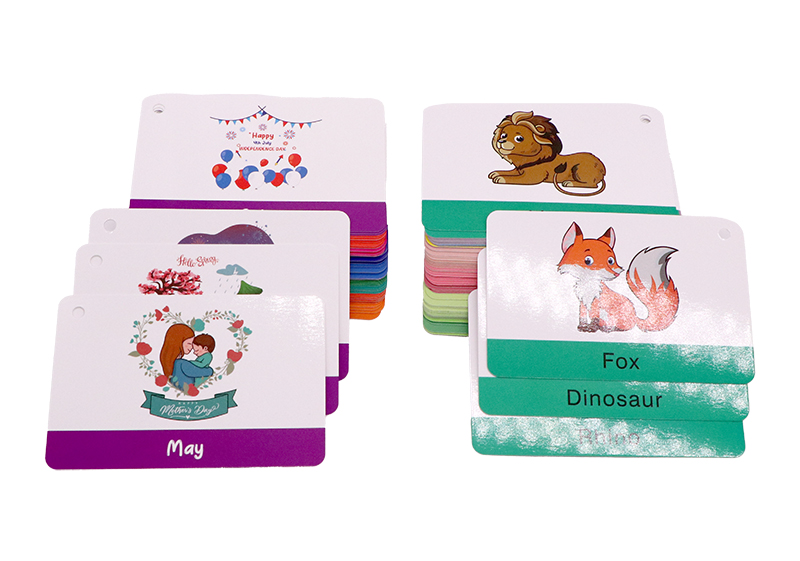
Preschool & Early-Learning Flashcards
Preschool products face frequent, unpredictable handling: cards get passed between children, dropped on tables and floors, touched with wet or sticky hands, and wiped between activities.
That doesn’t automatically mean every preschool deck needs a fully waterproof construction. If the goal is protecting printed graphics from routine moisture while keeping the cards easy to clean, a well-specified laminated surface usually strikes the right balance. If the cards are specifically designed for genuinely wet environments (bath time, water play), the construction should shift toward synthetic substrate.
Language-Learning Flashcards
A vocabulary deck may be used at home, in classrooms, and during tutoring — repeatedly, across multiple academic terms. For this category, long-term handling durability often matters more than maximum moisture protection. A brand typically gets more practical value from a finish that resists scuffing and repeated shuffling than from paying for waterproof performance most users will never test.
Teacher, Tutoring & Classroom Sets
Classroom decks are handled constantly but rarely exposed to sustained water. Priorities here shift toward:
- Low-glare readability
- Scratch resistance under repeated shuffling
- Consistent color reproduction across reorders
- Clean stacking and repackaging
Matte or anti-scratch matte lamination is typically the strongest fit — gloss can hurt readability under overhead classroom lighting.
Travel & High-Moisture Learning Products
Some products are intentionally designed for less controlled environments: travel decks, camp activity cards, outdoor programs, or kits used around water. Here, a stronger moisture-protection spec is commercially justified — the key is that the upgrade is tied to a defined product requirement, not chosen simply because “waterproof” sounds better on a product page.
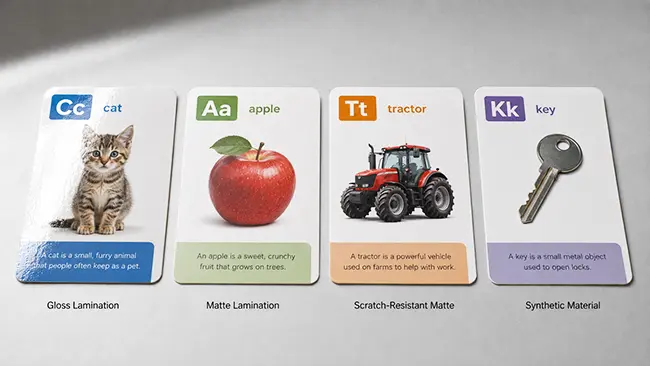
Lamination Finish Options Compared
Once the performance target is clear, the next step is choosing the right surface finish option from what’s available.
Quick Summary: Gloss lamination is the most budget-friendly and easiest to wipe clean; matte offers a premium, low-glare feel but shows scratches more readily; anti-scratch matte solves that problem for dark or heavily-handled artwork; varnish suits lower-cost, lower-handling projects; synthetic substrate is the only tier built for genuine wet-use.
| Finish Type | Cost Level | Durability Profile | Water Resistance | Best For |
|---|---|---|---|---|
| Gloss lamination | Low–Medium | Good surface protection, easy to wipe | Good for spills/smudges | Budget classroom flashcards |
| Matte lamination | Medium | Premium feel, may show scuffs | Good surface protection | Retail kits, branded decks |
| Anti-scratch matte | Medium–High | Better scuff resistance, smooth premium feel | Good surface protection | Dark artwork, high-touch products |
| Varnish/coating | Low–Medium | Lighter protection than film | Moderate | Cost-sensitive, low-handling projects |
| Synthetic substrate | High | Strongest moisture and tear resistance | Highest | Washable, outdoor, high-humidity use |

The Dark Design Trap
If your artwork uses large areas of solid black, navy, or other deep colors, standard matte lamination is a real manufacturing risk. Dark ink combined with standard matte film shows white/light scratch marks far more visibly than lighter designs — even from simple shuffling.
Factory Note: For dark, high-touch, or premium decks, upgrade to anti-scratch matte lamination. It costs slightly more but reliably prevents this issue and is strongly recommended for premium dark-background educational products.
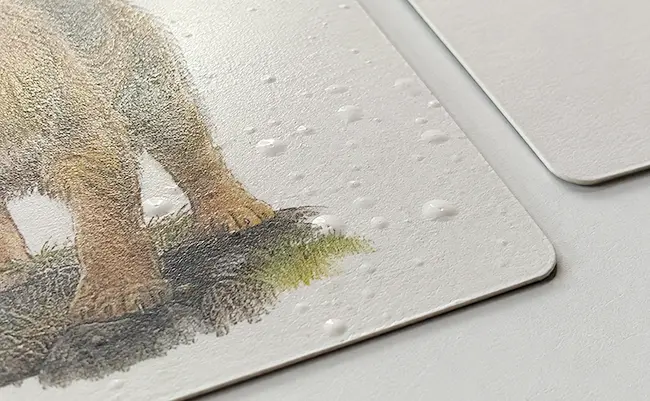
The Uncoated Paper Trap
If you’re using uncoated or watercolor-textured paper for an organic, tactile feel, do not apply standard film lamination. The film will trap air in the paper’s surface texture and cause visible bubbling during bonding. Pair uncoated stock with a liquid matte varnish instead of full film lamination.
Cost-Benefit: Is the Upgrade Worth It?
Quick Summary: The most expensive protection level isn’t automatically the most cost-effective one. Compare finishing cost against expected product lifespan, handling frequency, moisture exposure, and replacement risk — not just the unit price on the initial quote.
| Product Condition | Primary Priority | Typical Direction |
|---|---|---|
| Indoor classroom use | Cost + routine moisture protection | Water-resistant lamination usually sufficient |
| Preschool / high-frequency handling | Surface durability + moisture resistance | Balanced protective finish (anti-scratch matte) |
| Long-term language learning | Durability + usability | Evaluate lifespan before upgrading moisture spec |
| Frequent wet exposure | Moisture protection | Consider synthetic/higher-protection construction |
| Premium educational product | Durability + perceived quality | Weigh added finish cost against brand positioning |
| Travel / uncontrolled environments | Moisture + handling durability | Stronger overall protection justified |
Unit cost typically increases in stages — from varnish, to standard lamination, to edge-sealed lamination or synthetic substrate — with each step up adding a measurable premium over baseline. Exact figures depend on card size, order volume, and artwork coverage, so we recommend requesting a cost breakdown for your specific spec rather than relying on general industry benchmarks.
Insider Note: Clients who under-spec for a genuinely wet-use case often end up placing a second, more expensive rush order within the first year once cards fail in the field. Factor that reorder risk into your total cost comparison — not just the unit price on the initial quote.
Production Details That Affect Real-World Performance
Quick Summary: Beyond lamination choice, several construction details quietly determine whether a flashcard survives real-world use — paper core opacity, bleed and cutting tolerance, packaging fit, and shipping conditions all matter as much as the finish itself.
Paper Core Selection
For double-sided flashcards, show-through between the front and back printed content is a common complaint that lamination alone won’t fix. If your deck carries learning content on both sides, ask us about black-core or blue-core paper to reduce visibility from one side to the other before finalizing the lamination spec.
Bleed, Margins & Cutting Tolerance
Always include a 3mm (0.125″) bleed and a defined safe margin in your artwork files — review our guide on common bleed and safe margin requirements before sending files to press. Laminated and synthetic cards can shift slightly during die-cutting, so margins need enough buffer to avoid trimming into live content.

Packaging Fit
Lamination changes finished deck thickness and surface friction — which affects how cards stack, slide, and fit inside the box. For tight tuck box structures, test the finished laminated deck inside the final packaging before approving mass production. Shrink-wrap can deform lightweight boxes if the structure is soft; cello-wrap/BOPP with tear tape is generally the more reliable choice for premium flashcard sets.
Shipping & Storage Conditions
Even fully laminated or waterproof-rated cards can develop curling if exposed to swinging humidity during storage or transit. For sea freight, we typically cap outer cartons for laminated card stock around 12–15kg per box, with desiccant packs included per carton to prevent condensation-related curling inside the container.
Factory Note: Request a physical prototype before authorizing a full production run. Digital proofs cannot predict bubbling, edge behavior, color shift, or stacking performance — these defects only appear once a run actually goes through the laminator and cutting die.
Questions to Ask Before Approving a Waterproof Claim
Before approving packaging copy or sales language, confirm the following with us in writing:
- Is the card surface laminated, coated, or printed on a synthetic substrate?
- Are the edges exposed after cutting, corner-rounding, or die-cutting?
- Has the card been tested for spills, wiping, soaking, or humidity — and under what conditions?
- Can we provide a sample made with the final substrate, finish, and cutting method?
- Does “waterproof” apply to the complete finished card, or only the printed surface?
- Will the stated performance survive your product’s actual shipping and storage conditions?
Insider Note: If your retail packaging or online listing uses the word “waterproof,” make sure the claim has been verified under conditions matching real customer use. For most paper-based flashcards, “water-resistant” is the safer and more legally defensible claim — treat “waterproof” as a verified specification, not a shortcut for “laminated.”
How to Specify Your Order: RFQ Checklist
We can give a far more accurate recommendation — and quote — when the product requirement is defined upfront, rather than starting from a single finish name.
| RFQ Item | What to Specify |
|---|---|
| Card size | Finished dimensions |
| Quantity | Total decks / cards requested |
| Card stock | Preferred stock or target thickness/weight |
| Printing | Color and artwork coverage |
| Finish | Matte, gloss, anti-scratch matte, varnish, or synthetic |
| Moisture requirement | Routine resistance vs. verified waterproof performance |
| Usage environment | Classroom, home, travel, outdoor, medical, etc. |
| Expected lifespan | Short-term promotional vs. long-term classroom circulation |
| Packaging | Deck box, shrink-wrap, cello-wrap, or other format |
| Delivery | Destination and target schedule |
A brief like “preschool vocabulary cards used daily in classrooms and occasionally wiped clean” gives us far more to work with than “we need waterproof flashcards.” The first tells us exactly what the finished product needs to survive.
Final Recommendation
The right lamination spec is the one that matches your product’s real handling and moisture environment — not automatically the most expensive option on the price list.
- Choose water-resistant lamination when: the product is used indoors, exposed only to occasional spills, and produced at scale where unnecessary finishing cost matters.
- Choose anti-scratch matte when: artwork uses dark, solid colors or the product is positioned as a premium retail item handled frequently.
- Choose synthetic substrate or edge-sealed lamination when: cards will be repeatedly wet, cleaned frequently, or used outdoors, and long product life matters more than paper feel.
Get the substrate and edge-treatment decision right at the spec stage, and the rest of production follows naturally — with far fewer surprises once the order hits mass production.
Compare lamination samples side-by-side before you commit to a production run — request a sample pack from our team to see the durability difference firsthand.
Already know your exact specs and substrate requirements? Request a formal quote directly and skip the sample cycle.