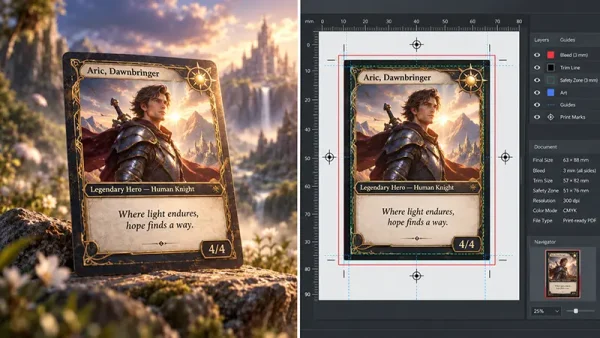
Author’s Note by Wensong Li, Prepress Design Director: I’ve spent my career on the factory floor, watching raw concepts turn into decks that ship by the tens of thousands. What’s changed in the last two years isn’t the machinery — it’s the speed at which ideas arrive at my desk. Generative AI has compressed months of concept art into days. But speed on the front end only matters if the back end can match it: the offset presses, the foil units, the die-cutters that turn a digital dream into something a player can shuffle, snap, and fall in love with.
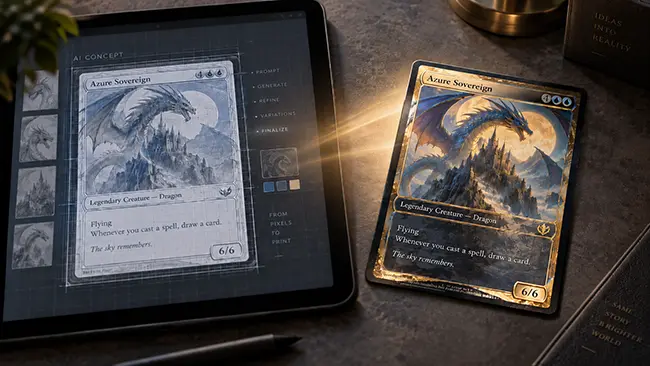
This piece is about that collision — where AI-driven design agility meets industrial-grade manufacturing, and why the brands getting this right are commanding margins nobody thought possible for a “simple deck of cards.”
Who This Guide Is For
Card manufacturing decisions touch a wider range of teams than most people expect. This guide is written for:
- Tabletop publishers planning premium card-based games
- Kickstarter and Gamefound creators structuring campaign tiers
- Tarot, oracle, and art deck brands building collector editions
- TCG teams developing booster packs or special-treatment cards
- Children’s game and educational card brands preparing for retail
- Procurement managers comparing custom card manufacturers
- Brand owners deciding between standard, deluxe, and collector SKUs
If your deck needs to do more than “look good on screen,” the decisions below will shape how customers experience, review, and remember your product.
The Physical Renaissance in a Digital Era
There’s a strange irony playing out across the tabletop industry right now. We live in an age of infinite digital content — streaming, screens, endless scroll — and yet physical playing cards are experiencing one of the strongest premiumization cycles the category has ever seen.
Players aren’t just buying decks anymore. They’re buying feel. The thickness of the stock, the crispness of the snap when you cut the deck, the way a spread fans out across a table without sticking — these tactile details have become genuine purchase drivers, not afterthoughts. Screen fatigue has, paradoxically, made physical objects more desirable, not less.
What’s powering this renaissance is a dual-engine flywheel:
- On the front end, generative AI has become the ultimate rapid iteration tool — design cycles that once took an entire quarter now take days.
- On the back end, offset lithography and advanced finishing techniques have matured to the point where a deck of cards can credibly compete with fine art prints and collectible packaging as a category.
Together, these two forces are pulling playing cards out of the “cheap game component” bin and repositioning them as high-margin, high-desirability collectibles.
What Players Actually Judge Now
Modern players and collectors evaluate more than illustration quality. They notice how the deck behaves in the hand:
- Card stock thickness — how substantial the card feels
- Snap and recovery — how well the card returns after bending
- Shuffle feel — whether the cards move smoothly or stick together
- Spread performance — how evenly cards fan across a table
- Surface texture — matte, linen, air-cushion, soft-touch, or coated
- Edge smoothness — whether the edges feel clean or rough
- Box presentation — how the packaging supports gifting, storage, and display
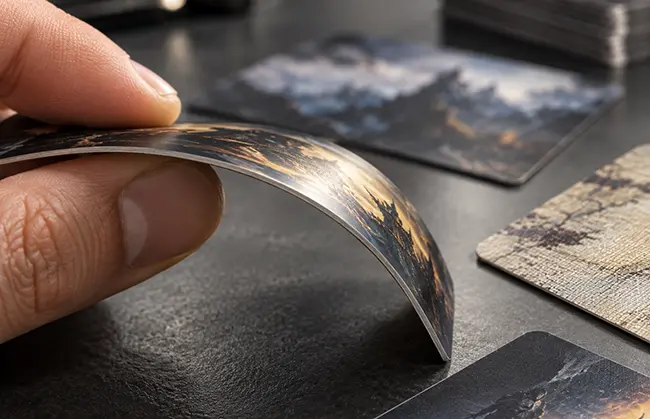
A beautiful illustration can attract attention, but the physical feel of the deck determines whether customers describe it as “premium” after they open the box. That’s the whole game now.
Trend 1: AI as the Infinite Prototyping Engine (Not the Final File)
The single biggest shift in card design workflows over the past two years has nothing to do with printing. It’s about how fast an idea can be tested before a single sheet ever touches a press.
Business Agility, Reimagined
Traditionally, developing a full 54-to-100+ card illustration set was a six-to-twelve-month commitment. Every visual direction change meant re-briefing an artist, waiting weeks for revisions, and absorbing the cost of every dead-end concept along the way.
That math has completely changed. Today, a single experienced art director, working alongside AI generation tools, can produce three fully distinct visual directions — say, a hard-edged cybernetic aesthetic versus an ornate neoclassical relief style versus a minimalist luxury system — in a matter of days, not months. The cost of exploring a “wrong” direction has dropped close to zero, which means teams can afford to be far more ambitious with their visual identity before committing to production.
The Rapid Blind Playtesting Workflow
Speed on the design side only creates value if it’s paired with a disciplined feedback loop. The publishers seeing the best results run something close to this:
- Generate AI concept art across multiple visual directions.
- Select 2–3 commercially viable routes.
- Produce 10 to 20 physical white-model proofs at the factory — real cardstock, real cuts, real handling.
- Ship those proofs to trusted playtesters, category KOLs, and campaign audiences across the US and Europe for blind feedback on gameplay and hand-feel.
- Lock the winning direction based on real-world response, not internal opinion.
- Move that finalized direction into full industrial vector redrawing for production.
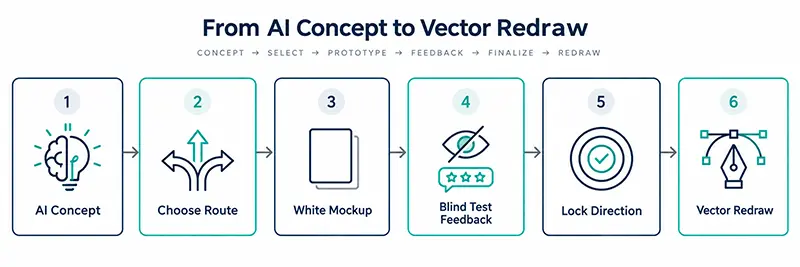
This loop matters because a screen never tells you how a card actually feels in a shuffle. Only physical proofs do.
Where the Human Has to Take Over
Here’s the part that separates a professional production pipeline from a hobbyist one: AI is exceptional at backgrounds, mood, and inspirational texture work. It is not, and should not be, responsible for anything that needs to survive contact with an industrial printing plate.
Card grids, vector pip placement, UI iconography, and rules text all need to stay firmly in the hands of a trained designer working in professional layout software. This isn’t a stylistic preference — it’s a hard production requirement. Getting it wrong is exactly what causes decks to arrive from the factory looking muddy, misaligned, or unreadable.
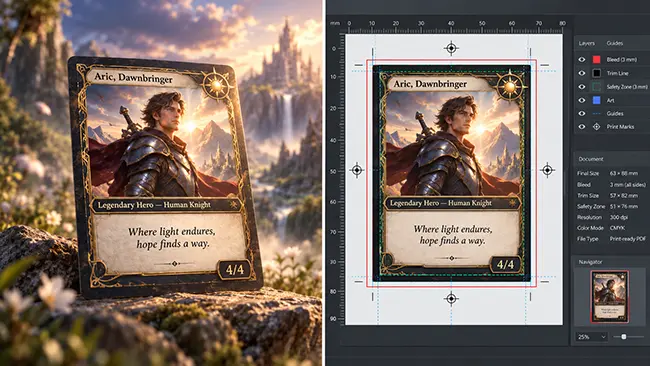
| Assigned to AI | Locked to Human Designers |
|---|---|
| Character portraits, backdrops, textures | Border registration, pip math, typography |
| Moodboards and thematic exploration | Bleed, safe zones, dielines |
| Campaign preview visuals | Color conversion, proofing, card-back symmetry |
If you want the full technical breakdown of exactly how that separation gets engineered at the file level — including layer architecture, color conversion, and die-cutting tolerances — our production team has put together a complete walkthrough:
Generating stunning art on screen is only step one. Bridging the gap between raw pixel outputs and industrial offset printing requires strict prepress parameters. Explore our actionable tutorial: From AI Concept to Offset Press: The Ultimate Manufacturer’s Prepress Guide to Commercial Card Production.
Trend 2: Multi-Sensory Luxury — Finishes, Foils, and Stretch Goal Economics
If AI has changed how fast a deck gets designed, finishing techniques are what determine how much someone is willing to pay for it once it’s real.
The Stretch Goal Economics
Let’s talk numbers, because this is where the business case gets genuinely compelling. Across the crowdfunding campaigns we’ve supported in recent years, a standard tuck-box deck — the kind most players think of as “a deck of cards” — typically retails in the $12−$18 range. That’s a commodity price point, and it behaves like one.
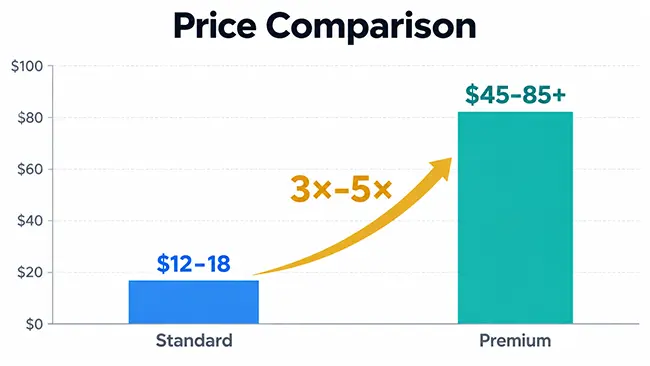
Now look at what happens when a crowdfunding campaign introduces a deluxe tier: holographic edge treatments, cold foil overprinting, a rigid box instead of a tuck box. Backers routinely pay $45−$85+ for that same core game — a 3-5× premium over the standard version. (Figures reflect aggregate pricing patterns observed across our crowdfunding client base; individual results vary based on category, audience size, IP strength, and positioning.)
That’s not a rounding error. That’s the difference between a project that barely covers manufacturing costs and one that funds a studio’s next three releases. The pricing power behind that multiplier depends on several real factors:
- Audience loyalty and IP strength
- Artwork quality and campaign storytelling
- Material choices and packaging design
- Scarcity strategy and quality of samples/photography
The best campaigns don’t add luxury finishes randomly. They use them to create a clear, felt reason for backers to upgrade.
Premium Finish Matrix
Different upgrades create different forms of perceived value — some improve hand-feel, some improve photography, some enhance collectibility.
| Upgrade | Perceived Value Driver | Best Used For |
|---|---|---|
| Cold foil overprinting | Full-color metallic gradients | Premium decks, TCG special cards |
| Hot foil stamping | Sharp, precise metallic accents | Logos, borders, tuck boxes |
| Micro-linen / air-cushion | Better handling and shuffle feel | Playing cards, poker decks |
| Spot UV | Gloss-matte tactile contrast | Card backs, collector boxes |
| Soft-touch varnish | Smooth premium hand-feel | Luxury boxes, tarot decks |
| Edge gilding | Shelf and unboxing impact | Tarot, oracle, limited editions |
| Rigid magnetic box | Gift-ready presentation | Deluxe Kickstarter tiers |
Why Air-Cushion Texture Punches Above Its Cost
One of the most effective — and most underrated — upgrades is a micro-linen air-cushion finish. Backers can’t fully evaluate a deck from a campaign video, but they can watch someone else handle it, and this is where texture does heavy lifting.
On an atomic scale, smooth calendered paper generates a near-vacuum adhesion when stacked under thumb pressure. Micro-linen embossing breaks that vacuum: micron-level textured rollers stamp thousands of tiny dimples into the surface, trapping pockets of air between cards. That’s what produces the distinctive resistant snap and the frictionless spread — the exact physical feedback that shows up in unboxing videos and gets quoted in campaign comment sections.
Cold Foil Overprinting: Democratizing Metallic Effects
Traditional hot foil stamping is expensive and limited — every color needs its own die, which makes multi-color metallic effects a budget-buster for most independent publishers.
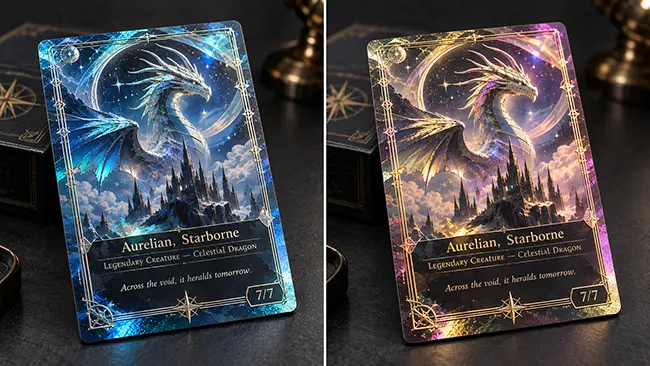
Inline cold foil overprinting changes that math. By laying down a full-sheet micro-fine silver foil base and then precision-printing CMYK inks directly on top of it, manufacturers can produce virtually unlimited full-spectrum metallic gradients — the kind of shifting, holographic color effect that used to be reserved for the rarest chase cards in major TCG releases. What was once an ultra-premium technique reserved for a handful of chase cards is now accessible to mid-run production volumes.
Manufacturing Reality Check
Luxury finishes raise perceived value, but they also add production variables. Before mass production, validate:
- Foil registration and coating compatibility
- Card curl risk and drying/rub resistance
- Edge consistency and box assembly tolerance
- Sample-to-mass-production consistency
A finish that looks impressive in a digital render may behave differently once it’s on real paper, under real coating, after real cutting. This is precisely why physical samples matter more than renders at this stage.
Trend 3: Sustainable Snap — The Green Engineering Shift
Here’s a trend that isn’t optional anymore, and any publisher planning to sell through major Western retail channels needs to understand it before locking in a manufacturing partner.
The ESG Defensive Shield
Retail buyers across major Western markets have tightened sourcing requirements considerably over the past two years. A significant driver behind this is the EU’s Deforestation Regulation (EUDR), which mandates traceability for paper-based products entering EU markets. The compliance timeline has shifted more than once since the regulation was introduced, and it’s worth knowing where things currently stand:
| Business Size | Compliance Deadline |
|---|---|
| Large and medium enterprises | December 30, 2025 |
| Micro and small enterprises | June 30, 2026 |
| Certain smallholder-linked supply chains | December 30, 2026 |
Compliance deadlines reflect EUDR timelines as of this article’s publish date. Given the regulation’s history of amendments, we recommend confirming current deadlines directly with your compliance counsel or the European Commission before finalizing sourcing decisions. EUDR obligations may also vary by product classification, supply chain role, and destination market — brands and importers should verify their own due diligence responsibilities.
The practical implication is straightforward: publishers working with manufacturers that don’t hold full FSC Chain-of-Custody certification are taking on real regulatory risk, and that window is narrowing rather than expanding. There’s also a secondary, less obvious effect worth planning around — anticipatory stockpiling ahead of each deadline has historically put upward pressure on certified paper pricing. Locking in a certified supplier’s capacity earlier is a cost-control move, not just a compliance checkbox.
Bio-Based Chemistry
The materials side of sustainability has moved just as fast. Mineral-based inks and high-VOC coatings are increasingly being phased out in favor of soy-based inks and water-based varnishes — formulations designed to meet standards such as EN71-3, ASTM F963, and phthalate-free requirements, without the environmental liability of older chemistry.
Requirements vary by product classification, age grading, and destination market. Testing should be performed by qualified third-party laboratories, and final compliance responsibility rests with the brand or importer of record.
The Core Rigidity Dilemma
Here’s the genuinely hard engineering problem hiding inside this trend: how do you maintain a deck’s snap and fold-memory once plastic film lamination is off the table?
Plastic lamination has historically been the easy answer to card rigidity — cheap, effective, and completely at odds with an EUDR-compliant, plastic-reduced sustainability position. Solving for rigidity without it requires high-density, pure paper-fiber cores paired with precisely engineered eco-friendly bonding layers between plies. It’s a genuinely difficult materials-science problem, and it’s one of the clearest differentiators between manufacturers who understand sustainable production and those who are simply attaching a green label to an unchanged process.
For a deeper look at how different paper core architectures actually perform under this constraint, our team has published a full comparative breakdown:
Sustainability does not require sacrificing card rigidity or hand-feel. Compare how different paper architectures perform in our definitive teardown: Game Card Materials Explained: Black Core vs Blue Core vs White Core.
Documentation Note
Certification, testing, and regulatory requirements vary by product type, age grading, destination market, and retailer. We help organize material documentation, FSC-related information, and testing coordination through qualified third-party labs where applicable — but final compliance sign-off should always come from your own regulatory counsel or testing lab. This protects both sides, and it keeps claims made on packaging and campaign pages honest.
Trend 4: Tiered Packaging Architecture & The Crowdfunding Playbook
Pricing tiers only work if the physical packaging visibly justifies the price gap between them. Packaging is the retail shelf’s front line and a Kickstarter backer’s first tactile handshake — and it’s where a lot of otherwise strong campaigns leave money on the table.
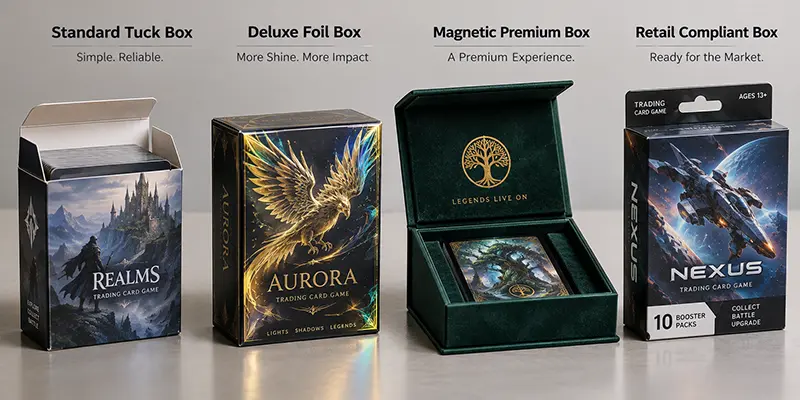
The Packaging Matrix
| Tier | Typical Construction | Commercial Role |
|---|---|---|
| Standard Player’s Deck | 300–330gsm blue core or black core, eco-friendly tuck box, matte varnish or linen finish | Accessible retail/player version, built for daily shuffling |
| Deluxe Kickstarter Tier | Upgraded black core, foil-stamped box, cold foil card backs, spot UV, premium insert | Higher pledge value, visible upgrade justification |
| Collector Edition | Rigid magnetic or book-style box, velvet/molded insert, edge gilding, serialized foil seal | Scarcity, gifting, display value |
| Retail Edition | FSC-certified paper options where applicable, compliant labeling, barcode | Distribution and store readiness |
The gap between tiers needs to be obvious within the first three seconds of unboxing. If a $70 collector’s edition doesn’t feel dramatically different from an $18 standard edition the moment it’s opened, the premium pricing won’t hold up in reviews or repeat purchases.
Anti-Cheat Blind Pack Production
For TCG publishers specifically, there’s a parallel manufacturing challenge: protecting rarity-distribution integrity inside sealed blind packs. This requires light-sealed production rooms, automated CCD optical verification systems, and foil-lined anti-tamper packaging designed to keep the rarity ratios printed on the box aligned with what’s actually inside — backed by continuous optical verification at every stage of production. For competitive TCG products, this level of process control isn’t a nice-to-have. It’s the foundation of consumer trust in the entire product line.
The Manufacturer’s Edge — Bridging Prototype to Scaled Production
None of the trends above matter if a manufacturing partner can’t actually execute at both ends of the production spectrum — fast, flexible prototyping and large-scale, quality-consistent delivery. This is, honestly, where I see the most promising crowdfunding campaigns get into trouble.
Dual-Track Manufacturing Agility
The best partners run two parallel capabilities:
- During campaign launch, they can turn around 10 to 50 physical proof sets for Kickstarter video footage, trade show samples, and playtesting sessions — fast enough to keep a campaign’s marketing timeline on track.
- Once funding closes, they pivot seamlessly into full-scale offset production on high-speed, multi-color press lines with inline cold foil units, delivering tens of thousands of decks without a meaningful quality drop-off between the prototype and the retail product.
That switch — from small-batch agility to industrial-scale precision — is where most manufacturing relationships actually break down. A shop that’s excellent at short-run proofing often can’t hold quality at 50,000 units, and a shop built for massive runs is often too slow and rigid to support a fast-moving campaign timeline.
Millimeter-Level Engineering Tolerance
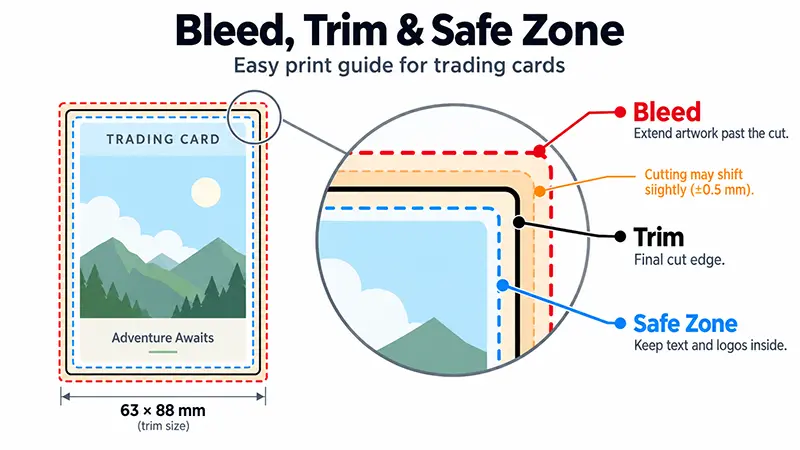
On the die-cutting side, CNC-controlled cutting presses hold tolerances to roughly ±0.5 mm depending on material and format — which is what delivers a clean, step-free edge across an entire deck: minimal burring, consistent card-to-card sizing, and a uniform, confident feel in the hand.
Curious how that ±0.5 mm tolerance actually translates into your file’s bleed and safe-zone requirements before it ever reaches the cutting press? See the exact engineering formula in our prepress guide.
QC Checkpoints That Actually Prevent Problems
Good QC isn’t about catching problems at the end — it’s about preventing small deviations from becoming large ones. Premium decks need checkpoints throughout production:
- Incoming paper inspection and color proof approval
- Press sheet inspection and foil registration checks
- UV/varnish consistency and coating rub resistance
- Die-cutting accuracy and corner-rounding consistency
- Packaging assembly inspection and final random sampling
One common source of disappointment we see: a mismatch between samples and bulk production. If a sample used digital printing while the bulk order runs on offset, color, surface finish, and hand-feel can shift. Samples should track final specifications as closely as possible — this matters enormously for Kickstarter projects, where backers compare final delivery against campaign photos and reviewer samples. Consistency protects trust.
Timeline Planning
Premium finishes, custom packaging, and compliance testing all require planning time. The earlier these requirements are confirmed, the lower the risk of rushed decisions before launch or delivery:
- Concept validation and specification planning
- Prototype sample production
- Artwork and packaging refinement
- Pre-production proof approval
- Safety or material testing where applicable
- Mass production
- Assembly, packing, and export preparation
- Buffer time for shipping, customs, and retailer intake
Kickstarter creators should be especially careful here — campaign pages often create public delivery expectations before all manufacturing risks are fully resolved.
How to Choose the Right Manufacturing Strategy for Your Deck
Different card products need different manufacturing priorities. A retail party game, a luxury tarot deck, a TCG booster product, and a Kickstarter collector deck shouldn’t all use the same specification strategy.
| Project Type | Manufacturing Priority | Recommended Features |
|---|---|---|
| Retail card game | Cost control and durability | Tuck box, blue/black core, standard finish |
| Kickstarter deck | Perceived value and storytelling | Foil, premium finish, rigid box, sample kit |
| Tarot / oracle deck | Luxury feel and gifting | Thick stock, matte finish, gilded edges |
| TCG product | Collation and anti-cheat control | Opaque packs, rarity tracking, optical inspection |
| Children’s game | Safety and documentation support | Rounded corners, relevant safety-oriented coatings, testing support where applicable |
Buyer Checklist Before Production
- What is the target retail price or pledge tier?
- Is the deck designed for heavy play, collecting, gifting, or retail display?
- Which card stock provides the right balance of opacity, snap, and cost?
- Does the project need FSC-certified paper options?
- Does the product require EN71-3, ASTM F963, CPSIA, or other testing support?
- Will samples and mass production use the same materials and processes?
- What QC checkpoints are required before shipment?
These questions help prevent late-stage specification changes — which are almost always more expensive than early planning.
Where to Go From Here
Whichever stage your project is at, there’s a clear next step.
Request the Next-Gen Tactile Sample Kit
If you’re still exploring materials and finishes — figuring out which core stock, texture, or foil treatment fits your campaign’s positioning — get the physical samples in your hands before you commit to anything on a spec sheet.

Feel the snap of German black core stock, the drag of a micro-linen air-cushion finish, and the shine of cold foil overprinting — before you launch your Kickstarter or lock in a production order. The kit also includes eco-friendly core alternatives so you can compare sustainable options side by side.
Request Your Free Tactile Sample Kit
Schedule an Industrial Pre-Production Consultation
If you’ve already got a live campaign or an annual production plan on the calendar, this is the point where a direct conversation with our production engineering team pays for itself.
Bring us your imposition layout, material mix, and cost targets. In comparable production runs, we’ve helped clients reduce manufacturing waste by 15–20% without compromising on quality or delivery timelines.
Schedule a Production Consultation with Our Engineering Team
FAQ
What is premium playing card manufacturing?
It’s the process of producing card decks with elevated attention to material selection, handling feel, surface finish, packaging, documentation, and quality control — going beyond simply printing artwork on paper. It commonly includes black or blue core stock, linen finish, foil effects, edge gilding, rigid packaging, FSC-certified paper options where applicable, and tight sample-to-mass-production control.
What finishes make a deck feel more premium?
Cold foil, hot foil stamping, micro-linen finish, spot UV, soft-touch varnish, edge gilding, and rigid magnetic boxes are the most common upgrades. Each creates a different type of value — linen improves handling, foil increases visual impact, spot UV creates contrast, edge gilding adds collector appeal, and rigid boxes improve giftability. The right combination depends on audience, usage, budget, and order quantity.
What card stock is best for premium playing cards?
Black core is often preferred for strong opacity, durability, and a professional feel. Blue core offers a good balance between cost and performance. White core may suit lighter-use or more economical projects. For collector decks, hand-feel and presentation tend to matter most; for gameplay-heavy decks, durability and shuffle performance take priority.
Do card games need FSC-certified paper?
Not every card game is required to use it, but FSC-certified paper options, where applicable, help brands selling into North America, Europe, bookstores, museum shops, children’s channels, or environmentally conscious markets. Any FSC claim or logo use should match the actual certification scope, material batch, and approved labeling rules.
What packaging works best for Kickstarter collector decks?
Foil tuck boxes, rigid magnetic boxes, book-style boxes, edge-gilded cards, custom seals, and numbered edition cards are the most common choices. The best packaging supports the campaign story while remaining practical for assembly, packing, shipping, and fulfillment — beautiful packaging still needs to survive real logistics.
How many prototype decks should creators order before launch?
Most creators order 10 to 50 prototype decks for campaign photography, videos, reviewer previews, playtesting, and packaging tests. Whenever possible, these samples should use materials and finishes close to the planned mass-production specifications, to avoid surprises when the final product ships.
What should publishers check before mass production?
Artwork completeness, material specifications, packaging structure, finish layers, sample approval, documentation needs, QC checkpoints, carton packing, and shipping protection — and specifically, whether the sample and bulk production will use the same paper, coating, finish, and packaging method. A signed production proof reduces confusion between brand and manufacturer.
Can AI-generated artwork be used for card printing?
Yes, but it usually needs professional preparation before offset production. AI is excellent for concept exploration; final files still require controlled typography, icons, bleed, color conversion, dielines, and proofing. See our AI card printing prepress guide for the full technical workflow.
How early should I contact a card manufacturer before launching a Kickstarter campaign?
Ideally before launch — especially if the project includes premium finishes, custom packaging, safety testing, FSC-related documentation, or international fulfillment. Early communication helps confirm sample feasibility, production costs, material options, packaging structure, and realistic lead times, reducing the risk of rushed changes after funding.
Can one deck be produced in both standard and collector editions?
Yes — many brands use the same core artwork while varying the card stock, surface finish, edge treatment, packaging, inserts, or numbered seals. This lets a single project serve both price-sensitive players and collectors, but it requires early planning around SKU management, packaging dimensions, assembly workflow, and fulfillment complexity.