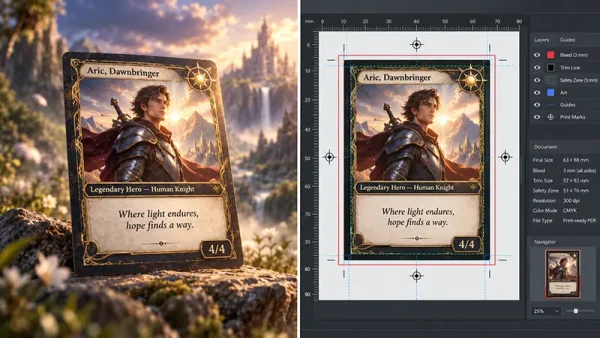
Author’s Note by Alex Deng, Production Manager: In twelve years on the production floor, I’ve watched hundreds of approved prototypes meet the offset press — and the transition is never as simple as hitting “copy.” Color shifts, die-cut tolerances, ink coverage on dark designs: these aren’t hypothetical risks, they’re the exact details that separate a smooth bulk run from a costly reprint. Here’s what you need to know before your files leave the prototype stage and head to full production.
Every card game publisher eventually faces two very different printing conversations.
The first is about testing — getting a physical deck in hand to check the feel, the balance, the layout.
The second is about scaling — committing real budget to a production run that will ship to retailers, backers, or distributors.
This guide walks through both stages. Since our facility handles everything from a single prototype run to a full bulk order, we’ll also flag the technical checkpoints that most generic printing guides skip entirely.

What Is Card Game Prototype Printing? A Breakdown for First-Time Publishers
Quick Answer: Card game prototype printing is a short-run print process used to test layout, card feel, and gameplay balance before committing to a full production order. It typically relies on digital short-run printing rather than offset presses. Turnaround is faster, but per-unit cost is higher than bulk production. Most publishers order a small batch to playtest and gather feedback before scaling up.
A prototype run exists to answer one question: does this design work in the real world, not just on screen?
At this stage, publishers are typically validating:
- Card stock feel in hand
- Print clarity at small text sizes
- Whether the layout survives the trim
Factory Note: One of the most common (and preventable) issues I’ve seen on rushed prototype orders is ink transfer — cards packed and shipped before the ink has fully cured, especially on dark, ink-heavy designs. The result is faint ghosting or smudging on the card sitting above it in the stack. If you’re on a tight deadline, tell your manufacturer up front and ask whether extra drying time or a protective interleaving sheet should be built into the schedule, rather than compressing the timeline on the back end.
Digital Short-Run Printing vs What Happens at Bulk Volume
Prototype orders are almost always produced on digital presses.
Digital printing doesn’t require the setup cost or minimum volume that offset (litho) printing does.
This makes it economical to print a handful of decks.
But it also means the color and material behavior you see at prototype stage isn’t automatically identical to what offset printing will produce later — a point we unpack in detail further down.

Coated card stock vs Uncoated stock
Common Card Stock and Finish Choices Used at Prototype Stage
Publishers usually choose between:
- Coated card stock — smoother, more vibrant print finish
- Uncoated stock — more tactile, “paper-like” feel
One important physical note: if you’re testing an uncoated or watercolor-style stock, avoid pairing it with lamination or foil edges at this stage.
Uncoated fibers don’t bond well with laminate film or foil adhesive, which can cause bubbling or peeling. A matte varnish coating is the safer choice for uncoated stock samples.
What this means for you: choosing the wrong finish combo at prototype stage doesn’t just look bad — it can waste an entire test run and push your timeline back a full production cycle.
For a full breakdown of stock weights and finish combinations available across card categories, you can compare stock weights and finish options in our card stock and finish guide.
How to Print a Card Game Prototype for Playtesting: A Step-by-Step Process
Quick Answer: To print a card game prototype for playtesting, you’ll need print-ready files in CMYK color mode with a 3mm (0.125″) bleed, a chosen card stock weight, and a confirmed quantity — usually a small batch. Most manufacturers can turn around a digital prototype faster than a full production run. Expect a proof review step before your prototype ships.
Factory Note: The single most common file error I catch before it becomes a production problem is a leftover die-line layer — the cutting guide the designer used while laying out the file — that never got deleted or set to a non-printing layer. It sits invisibly in the design software but shows up as a thin printed line on the finished card. Always double-check your final export against your original template layers before submitting.
File Prep Requirements Before Submitting a Prototype Order
Print files must be submitted in CMYK color mode, not RGB.
Screen colors (RGB) are display-only values — they don’t translate directly to ink on paper.
Submitting RGB files is one of the most common reasons a prototype comes back looking noticeably different from the on-screen mockup.
Every file also needs a 3mm (0.125″) bleed around the trim edge so background art and borders don’t show a white sliver after cutting.
If your deck design includes a brand logo, a specific dark background, or any color you plan to reuse consistently across future print runs, it’s worth specifying a Pantone spot color reference at the file prep stage rather than relying on CMYK approximation alone.
What this means for you: locking your brand colors to a Pantone reference now saves you from a much bigger headache later, when batch-to-batch consistency matters far more than it does for a one-off prototype.
Realistic Turnaround Expectations for Small-Batch Runs
Digital short-run printing generally turns around faster than offset production simply because there’s no plate-making or press setup involved.
Exact turnaround will vary by card category, finish, and current production queue.
As a general industry benchmark, digital prototype orders typically turn around in 7–15 business days from file approval (industry-standard range — confirm exact specs with your supplier before production).
What this means for you: you can plan playtest sessions or a crowdfunding launch window around a realistic timeline, instead of guessing and getting caught off guard.
But here’s where most generic printing guides stop — and where the real risk to your bulk order actually begins.
Offset vs Digital Printing for Card Games: Which One Fits Your Production Stage?
Quick Answer: Digital printing is used for prototypes and small batches, while offset (litho) printing takes over at higher volumes for lower per-unit cost. The two processes render color differently — digital uses direct CMYK output, while offset relies on spot-color or separation plates. This means an approved prototype color is not automatically guaranteed to match your bulk production run without a pre-production proof.
This is the section most generic printing articles skip, and it’s arguably the most important technical detail in this entire guide.
Insider Note: I’ve watched more than one publisher panic when their bulk order came back slightly warmer or cooler than their digital prototype — not because anything went wrong, but because they were comparing two fundamentally different color-building processes. On one run with large flat color blocks, we caught visible banding on the digital proof that simply wasn’t present once the same file ran on offset plates, because offset lays down ink in a much smoother, continuous film. Don’t assume a flawless digital proof guarantees a flawless offset result, and don’t assume the reverse either — always request a press proof for color-critical designs.
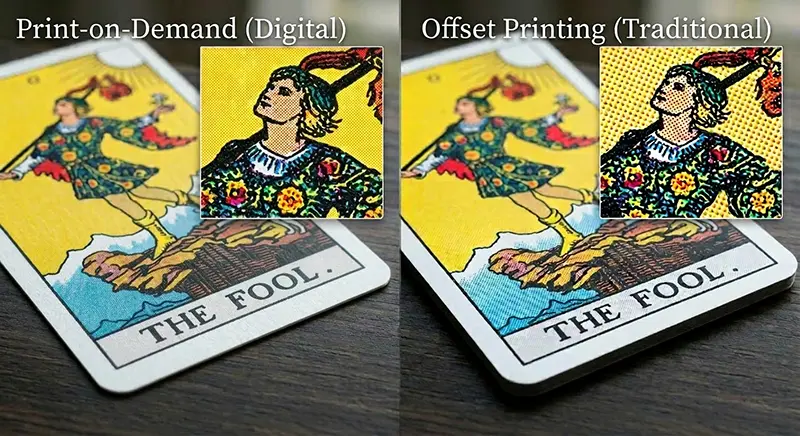
Why Your Approved Prototype Color May Shift Once You Move to Bulk Printing
Digital presses build color directly from CMYK toner or inkjet output, card by card.
Offset presses build color through separation plates, laying down ink in controlled, repeatable layers across a much larger run.
These are fundamentally different color-rendering methods.
A deck that looks perfect on a digital prototype can shift slightly once it’s reproduced on an offset press — especially with deep purples, neon tones, or precise brand colors.
This is known industry-wide as batch color variance.
What this means for you: an approved prototype color isn’t a guarantee of your final bulk-run color. Insisting on a press proof before sign-off protects your brand colors from ending up subtly “off” across thousands of units.
Paper Stock Availability Thresholds: What Changes at Higher Print Volumes
Certain specialty stocks — including black-core and blue-core papers used for opacity — are only cost-efficient to run once volume clears a certain threshold on an offset production line.
At prototype stage, manufacturers sometimes substitute a comparable stock just to approximate the hand-feel.
This means the exact material in your hands during testing may not be the exact material used at bulk volume.
What this means for you: always confirm with your manufacturer which stock is being used at each stage — not just at final production — so there are no surprises when your bulk order arrives.
Why a Pre-Production Press Proof Matters More Than Your Original Prototype
A digital proof and a press proof are not the same thing.
Treating them as interchangeable is one of the most common — and costly — mistakes publishers make.
- A digital proof shows you what the design looks like on a digital output device
- A press proof shows you what the design actually looks like coming off the offset press that will run your full order
There is a natural, expected color difference between the two. Publishers signing off on a bulk order should understand what a reasonable tolerance range looks like before approving — not after receiving a finished shipment that doesn’t match expectations.
To see how this plays out in a real production run, take a look at one of our past offset production case studies.
Prototype Printing vs Bulk Card Game Production: Key Differences That Affect Your Budget
Quick Answer: Prototype printing and bulk production differ in cost structure, quality control checkpoints, and material sourcing. Prototype runs prioritize speed and flexibility over unit cost, while bulk runs prioritize cost efficiency and consistency at scale. Quality control also shifts from single-piece review to statistical sampling at bulk volume.
Factory Note: New die-cutting tools don’t always run true right out of the gate — there’s often a short “bedding-in” period at the start of a run where registration can drift slightly before the blade seats fully. That’s exactly why a smart quality control process pulls samples from the beginning, middle, and end of a production run, not just the first box off the line. Relying only on the first few sheets can give you a false sense of confidence.
Cost-Per-Unit Behavior: Why Small Batches Cost More Per Card
Digital printing carries a relatively flat per-unit cost regardless of quantity.
Offset printing has a higher upfront setup cost that gets diluted across a much larger run — which is why per-card cost drops sharply once you cross into bulk volume.
What this means for you: this is a structural difference in how the two processes are priced, not a negotiable discount. Understanding this upfront helps you set realistic budget expectations before you request a quote.
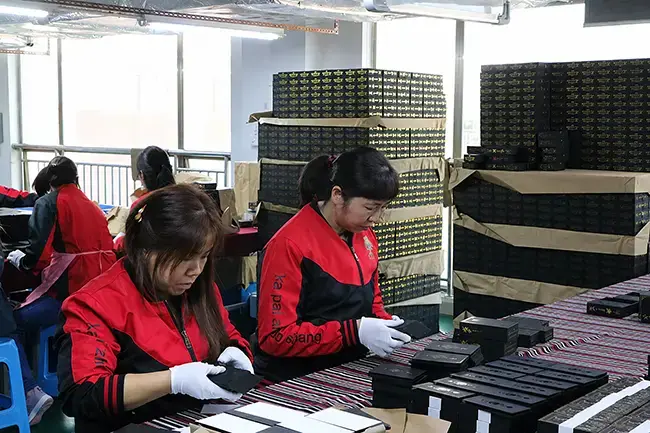
Quality Control Checkpoints That Only Apply at Bulk Volume
At small batch sizes, it’s realistic to visually check every single card.
At bulk volume, quality control shifts to statistical sampling across the run.
One checkpoint that becomes especially relevant here is die-cut registration:
- If your card back design uses a thin border rather than a full-bleed edge-to-edge design, even a small die-cut shift during high-speed cutting can create a visibly uneven border
- As a general rule, border designs should maintain a minimum thickness of roughly 3mm, or use a full-bleed, borderless back design to avoid this risk entirely at scale
What this means for you: a thin card-back border that looks flawless in your prototype won’t turn into a visibly crooked line once it’s running at bulk speed.
Custom Prototype vs Free Production Samples: Which Should You Request First?
Insider Note: I’ve seen publishers spend their entire prototype budget on a fully finished custom prototype — premium finish, foil accents, the works — only to change the card back layout two weeks later after a playtest session. That finish work has to be redone from scratch. A smarter sequence is to lock the layout first with a plain-finish custom prototype, then order a second, finish-matched round only once the design is genuinely frozen.
Before committing budget to a custom prototype, it’s worth understanding that there are actually two very different ways to get a physical card in your hands — and they serve two different purposes.


Paid Custom Prototypes: Why Pricing Varies by Card Category
A custom prototype — built to your exact design, stock, and finish specifications — is a paid service, and the price is not a single fixed number.
It depends on several variables working together:
- Card category (Poker, TCG, Collectible, Standard Game Cards, Learning Cards)
- Paper stock weight and core type — TCG and poker-style decks often require a black-core or blue-core paper to prevent light from showing through the card when held up, which is a different (and typically higher-cost) material than a standard single-ply stock
- Surface finish — including whether the deck includes holo foil elements, which require careful humidity control and a balanced double-sided varnish or lamination to prevent long-term curling
- Rulebook or insert inclusion — a rulebook over roughly 32 pages using saddle-stitch binding typically requires creep allowance adjustments in prepress, or may be better suited to perfect binding
- Packaging choice — a tuck box, a rigid two-piece box, or no packaging at all each carry different material and assembly costs
Because of this many-variable structure, pricing is determined by our sales team based on your final specifications — a flat, one-size-fits-all number simply isn’t accurate given how much these factors interact.
For a real quote, submit your card category, stock choice, finish, and packaging preference, and we’ll price it based on your actual spec sheet.
What this means for you: instead of a generic “starting at” number that falls apart the moment you submit real files, you get a quote that reflects your actual project — with no surprise invoice later. Any manufacturer offering a flat rate without asking these questions first should be treated with caution.
Free Production Samples: What They Show and How to Request Them
Separately, you can request free samples of our past production work across different card categories — the only cost is shipping.
This is a lower-commitment way to evaluate print quality, stock feel, and finish options before investing in a paid custom prototype built to your own design.
You can browse and request free production samples by card category on our sample request page.
When Should You Move From Prototype to Bulk Production?
Quick Answer: You’re ready to move from prototype to bulk production once your design is finalized, your prototype has passed playtesting without further layout changes, and you’ve reviewed a pre-production proof for color and material accuracy. Skipping the proof step is the most common reason publishers receive bulk orders that don’t match their approved prototype.
Insider Note: The publishers who run into trouble almost always have one thing in common: a crowdfunding or retail deadline that made them skip the press proof step to save a week. That single week saved at approval has a habit of turning into four to six weeks of delay if the bulk run comes back off-spec and has to be corrected and reprinted. The proof step isn’t the bottleneck — skipping it is.
Signals Your Design Is Ready for a Bulk Manufacturing Commitment
A design is typically ready to scale once:
- Playtesting feedback has stabilized
- The file has been finalized in CMYK with correct bleed
- Any brand-critical colors have been locked to a Pantone reference rather than left as CMYK approximations
What Happens During Sample Approval Before a Bulk Order Is Locked In
Before a bulk order goes to press, most manufacturers will provide a pre-production proof for sign-off.
It’s worth remembering here what we covered earlier: a digital proof and a press proof carry a natural, expected color difference.
What this means for you: when you sign off on a sample before bulk production, confirm which type of proof you’re approving, and ask your manufacturer to explain the acceptable tolerance range for that specific proof type — before, not after, your units ship.
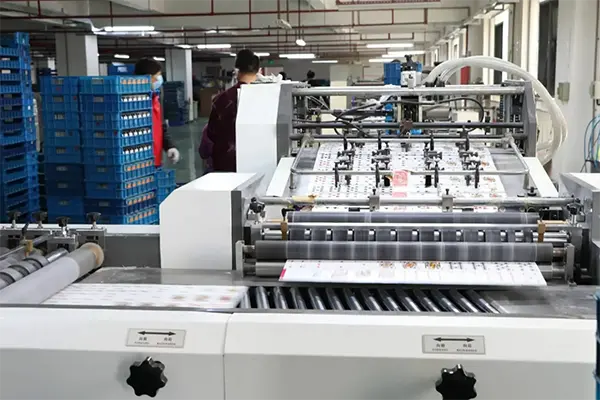
What Does a Card Game Production Run Cost? Budgeting Factors for Your First Bulk Order
Insider Note: One budgeting mistake I see constantly: publishers quote themselves a per-card price from an online calculator, then forget that packaging assembly labor, international freight, and customs duties are almost never included in that headline number. By the time the full landed cost is calculated, the real per-unit cost can look very different from the number they budgeted around. Ask your manufacturer for a full landed-cost breakdown, not just a factory-gate card price.
Core Cost Factors — MOQ, Card Stock, Finish, and Packaging
Bulk production cost is driven by a combination of factors, not a flat per-deck rate:
- Minimum order quantity (MOQ) — varies by card category and finish complexity
- Card stock weight and core type
- Finish complexity — spot UV coating and foil stamping cannot physically overlap in the same design area without risking foil lift, so any design combining both needs the layers positioned separately rather than stacked
- Large dark or near-black design areas — these require ink management (typically a rich black build with total ink coverage kept at or below roughly 300%, rather than a flat four-color solid black) to avoid drying and rub-off issues, and often call for an anti-scratch matte lamination upgrade if the design is heavily dark-toned
- Packaging — a rigid greyboard box wrapped in printed paper, or a folding tuck box, each with different material and assembly costs
What this means for you: managing ink coverage correctly means your dark, moody card designs won’t come back with rub-off ink or a dried-out matte finish — the print holds up in players’ hands for years, not months.
Because these variables interact differently for every project, final pricing is confirmed by our sales team once your spec sheet is complete — we don’t publish a flat number because it wouldn’t hold up across different card categories and finishes.
As a general rule, higher order volumes bring the per-unit cost down, and any manufacturer quoting you a flat number without reviewing your specs first should be asked how they arrived at that figure.
Why We Ask for Your Spec Sheet Before Quoting a Single Price
This isn’t a stalling tactic — it’s the only accurate way to price a run built from this many independent variables.
What this means for you: a manufacturer willing to quote a single flat number without knowing your card category, stock, finish, and packaging is either guessing, or applying a generic rate that may not hold once your actual files are reviewed.
Here’s the part most suppliers won’t tell you until after you’ve already signed the invoice.
Finding the Right Bulk Custom Playing Card Manufacturer: What to Vet Before You Commit
Insider Note: A red flag I’d tell any publisher to watch for: a manufacturer that gives you a single flat price before ever asking for your spec sheet, card category, or finish details. Pricing this business accurately requires knowing those variables — a supplier skipping that step is either quoting a generic rate that won’t survive contact with your real files, or padding the number to cover their own uncertainty.
Questions to Ask a Wholesale Card Game Printing Supplier Before Signing Off
- Which proof type (digital vs press) will you review before the bulk run is locked in?
- What is the acceptable color tolerance range between that proof and the final production run?
- Which paper stock and core type will actually be used at bulk volume — is it the same material used in your prototype?
How Minimum Order Quantity Scales With Card Category and Finish Complexity
MOQ isn’t a single universal number across every manufacturer.
As a baseline, our minimum order starts at 200 decks across card categories.
Beyond that baseline, specialty materials — like black-core or blue-core stock for TCG and poker-style decks — may carry a higher practical minimum, simply because those materials are sourced in larger production batches.
What this means for you: a 200-deck baseline gives you a realistic way to validate market demand or fulfill a first retail order without locking up cash in inventory you can’t move. As a general rule, ordering above the baseline minimum brings your per-unit cost down, so it’s worth discussing your target quantity with your manufacturer early rather than defaulting to the smallest possible order.
Ready to Move From Prototype to Bulk Production?
If you’re still validating your design, start with a free production sample from a category close to your own project. It costs nothing but shipping, and it’s the fastest way to see real print quality in hand.
If you already have a finished design and you’re ready to test it exactly as it will look in production, request a custom prototype quote with your spec sheet.
If your prototype has already passed playtesting and you’re ready to scale, request a quote for your 200+ unit run — our team will walk you through the pre-production proof process before you commit to a full bulk order.