
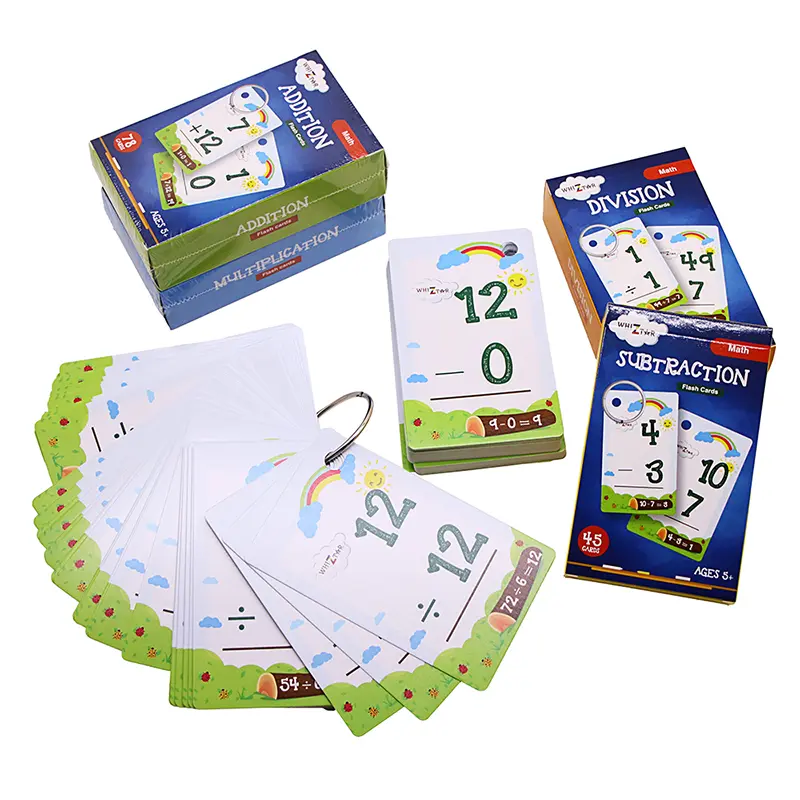


OEM Production Reference — Not for Retail Sale
This page documents a completed OEM production run manufactured for a private-label client’s educational flashcard product line.
The specifications, materials, and finishes shown below are recorded directly from the actual finished set.
This sample is presented for reference and factory-capability demonstration purposes only. It is not available for individual retail purchase.
This set required three physically distinct paper-based components to be finished with matching matte lamination, so the full set reads as one cohesive product rather than three separately sourced parts.
The card stock, the tuck box board, and the rigid box shell each use a different base weight — 350gsm, 300gsm, and 157gsm over 1200gsm respectively.
The outer 2-piece rigid box also had to accommodate four individually finished tuck boxes of unequal card counts (78, 45, 78, and 72 cards) plus four metal binder rings, without dimensional slack that would allow the boxes to shift or rattle during handling and shipping.
For buyers exploring similar custom flash card set printing projects, this sample illustrates how a multi-component packaging structure can hold consistent tolerances across mismatched substrate weights.
| Parameter | Value |
|---|---|
| Size | 70 x 120 mm (2.75″ x 4.75″) |
| Material | 350gsm art paper |
| CMYK printing | |
| Surface Finish | Matte lamination |
| Total Card Count | 273 |
| Total Equations | 546 |
| Parameter | Value |
|---|---|
| Box Type | Custom tuck box |
| Material | 300gsm white paperboard |
| 4-color offset printing | |
| Surface Finish | Matte lamination |
| Parameter | Value |
|---|---|
| Box Type | Custom 2-piece rigid box |
| Material | 157gsm art paper + 1200gsm grey chipboard |
| 4-color offset printing | |
| Surface Finish | Matte lamination |
| Box Contents | 4 tuck boxes + 4 metal binder rings |
| Parameter | Value |
|---|---|
| Number of Decks | 4 |
| Addition Deck | 78 cards |
| Subtraction Deck | 45 cards |
| Multiplication Deck | 78 cards |
| Division Deck | 72 cards |

Outer Box / 2-Piece Rigid Box
A 2-piece rigid box built on 1200gsm grey chipboard was chosen over a folding carton.
It needed to withstand repeated opening, closing, and transport across classroom or household use.
The rigid structure also positions the full set for gift-style presentation rather than disposable classroom consumables.

Custom Tuck Box
Splitting 273 cards into four individually boxed decks — addition, subtraction, multiplication, and division — lets a single operation be pulled out and used on its own.
No sorting through the full card count is required.
Each tuck box is sized independently, meaning the internal cavity of the outer rigid box had to be dimensioned around four boxes of differing stack heights, not one uniform block.

Metal Binder Rings
All 273 cards are pre-punched and held on four metal binder rings, one ring per deck.
This keeps each set of equations in sequence and prevents individual cards from separating during active use.
It also allows quick deck-by-deck rotation without loose cards being misplaced.

Matte Lamination Finish
The same matte lamination finish was applied to the 350gsm cards, the 300gsm paperboard tuck boxes, and the 157gsm-over-1200gsm rigid box shell.
Running one finish across three different base weights reduces surface glare under classroom lighting.
It also supports smoother card flipping and shuffling, producing a single unified tactile impression across three separately constructed components.
Factory Note: The 350gsm cards on this run went through matte film lamination before die-cutting, which is where the real risk sits.
At 70 x 120 mm with rounded corners, the combined thickness of the card stock and the laminate film puts extra shear load on the die blade right at the corner radius.
This is the point where lamination film most commonly chips or lifts if blade pressure isn’t recalibrated for the laminated stack versus bare stock.
Because all 273 cards across the four decks were nested tightly on the press sheet to maximize yield, die pressure was dialed in incrementally on test sheets before the full run.
Corner edges were checked under magnification for film separation before committing to the full 78/45/78/72 card breakdown.
Getting this wrong doesn’t show up until the cards are shuffled a few dozen times and the laminate starts peeling at the corners — exactly where flashcards see the most wear.
This nested tuck box and rigid box configuration is available for physical review.
Buyers evaluating a comparable multi-deck packaging structure — educational cards, multi-set card collections, or similar segmented packaging — can request a sample pack, use this spec as reference for a new project, or inquire about this finish for their own card and box combination.


