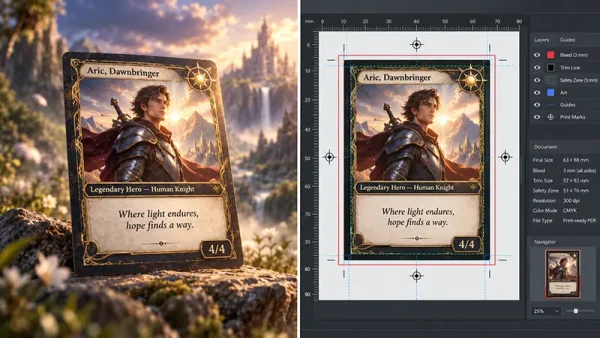
Trading card games have a special kind of magic. The weight of the deck in your hand, the snap of a clean shuffle, the vivid artwork on every card — all of this depends on one thing: how those TCG cards are printed.

If you are a publisher, game designer, artist, or individual creator planning your own TCG, trading card, or collectible card project, understanding the printing process is not just “nice to know”. It directly affects:
- How professional your cards look and feel
- How consistent each print run will be
- How easily you can communicate with your printing factory
This guide is written for:
- Publishers and game studios planning professional TCG or trading card runs
- Indie creators and designers working on their first card game or crowdfunding project
- Artists and illustrators who want to turn their artwork into collectible cards
- Individual users who need small‑batch, professional‑quality decks
We’ll walk through how TCG cards are printed step by step, highlight common risks, show you how to choose a reliable TCG card printing supplier, and explain how ACELION supports different types of customers with small MOQs and fast prototyping.
TCG Card Printing Basics: What Makes a Professional Card?
Before diving into the detailed TCG card printing process, it helps to know what makes a deck feel “professional” instead of “cheap and toy‑like”.
Standard Sizes and Formats
Most TCG and trading cards follow a few standard sizes. One of the most common is around 63 × 88 mm, similar to the classic trading card game format. Depending on your idea, you might also consider:
- Smaller “mini” cards for certain mechanics
- Oversized cards for bosses, heroes, or special collectibles
If you are unsure, a good trading card printing supplier will recommend standard sizes that:
- Fit common sleeves
- Use paper efficiently
- Keep costs predictable
Card Stock and Core
Professional TCG and collectible cards are printed on specialized playing card stock with an opaque core layer. The most common options are:
- Black core card stock – Helps prevent light from passing through the card, reducing “see‑through” issues. This is often used for higher‑end or competitive decks.
- Blue core card stock – A more economical choice that still offers good stiffness and opacity for many casual and mid‑range projects.
Key technical factors that matter in real use:
- GSM / thickness –
- Too thin → cards feel flimsy and bend easily.
- Too thick → hard to shuffle and uncomfortable in the hand.
- Stiffness and memory – Good cards bend slightly when shuffled, then recover their shape instead of staying warped.
If you’re not sure where to start, most first‑time TCG creators choose a standard black‑core stock with medium thickness. It’s a safe, well‑balanced option for both play and shuffling.

Surface Finish and Handling
The surface finish strongly changes how the card looks on the table and feels in the hand. Typical options in TCG card printing include:
- Varnish – A light protective coating with a subtle sheen, often the most economical way to protect the print.
- Matte lamination – Smooth, non‑shiny surface that reduces glare and fingerprints, popular for modern TCGs and collectible decks.
- Glossy lamination – Shiny finish with very strong color contrast; good for bold, vibrant artwork.
- Linen finish – Embossed texture that gives cards a premium tactile feel and improves shuffle performance.
In practice, what really matters is how your card stock + core + finish work together in the hand. That combination is at the heart of professional TCG card printing.

How Are TCG Cards Printed? Step‑by‑Step Process
Let’s walk through how TCG cards are printed, from your artwork files to finished, shrink‑wrapped decks. Different factories may vary in some details, but the core trading card printing stages are similar.
1. Artwork Preparation and File Setup
Every great deck starts with solid artwork files. This is where we often see creators make avoidable mistakes.
Most factories will ask for:
- High resolution – 300 dpi or higher for clean print quality
- CMYK color mode – Not RGB, to match printing reality
- Bleed area – Typically 3 mm beyond the final card size, so tiny shifts in cutting don’t leave white edges
- Safe zone – Important text and icons kept a few millimeters away from the trim line
- Consistent templates – All cards aligned to the same layout, especially if you use borders
A professional custom TCG card printing supplier will provide templates and a simple file checklist. In our daily work at ACELION, we often help creators adjust small things—like border thickness or text placement—because fixing them at the file stage is far cheaper than discovering issues after printing.
2. Choosing the Right Card Stock
Next, you and your printer choose:
- Card stock type – black core or blue core
- Thickness (GSM / caliper) – tuned to your game’s needs
- Special requirements – for example:
- Extra stiffness for competitive play
- Softer, more flexible feel for casual or kids’ games
This choice affects:
- How the deck shuffles
- How long it lasts under real play
- Whether cards are visible through strong backlighting
If you have no printing background, the easiest path is to request a stock and finish sample kit. Most specialized TCG card printing factories, including ACELION, can send sample cards so you can compare options in your hand instead of guessing from a PDF.
3. Printing Process: Offset vs Digital
For professional TCG card printing and collectible card printing, there are two main technologies:
- Offset printing
- Best for medium to large runs
- Very stable color and sharp details
- Lower cost per deck when you print higher quantities
- Digital printing
- Ideal for small batch TCG card printing and prototypes
- Minimal setup time, good for 100‑deck MOQs or trial runs
- Slightly different look vs big offset runs, but perfect for early testing
For most indie creators and first‑time projects, starting with a small digital run of 100–200 decks is safer than jumping straight to 1,000+ decks on offset. Once you are happy with the deck’s feel and feedback, you can scale up.
4. Color Management and Proofing
Color is where many beautiful card projects go wrong if there is no proper proofing.
A reliable trading card printing supplier will help with:
- Color profiles and CMYK conversion
- Digital proofs (PDF or online) for layout and basic color feel
- Physical print proofs on your chosen stock and finish for final approval
This is your best chance to:
- Check gradients and dark areas that can easily lose detail in print
- Ensure card fronts and backs match well
- Confirm your brand colors and skin tones look as expected
If you are an artist or illustrator, this stage is especially crucial. Fine textures, subtle lighting, and illustration details can shift a lot from screen to print. A physical proof is the safest way to protect your artwork.
Skipping physical proofing is one of the top reasons people end up unhappy with TCG card printing. At ACELION, we strongly recommend signing off on a physical sample for any new deck or major design change.

5. Coating and Finishing
After printing, the cards are coated and finished. Typical options include:
- Aqueous or UV varnish – Adds basic protection and a slight sheen
- Matte lamination – Gives a soft, modern look with low reflections
- Glossy lamination – Makes colors pop and feels slick
- Linen finish – Adds a light texture many players associate with premium decks
- Special effects (if offered):
- Foil stamping for logos, titles, or borders
- Spot UV to highlight selected areas
- Holographic or metallic effects for rare or chase cards
If your project is mainly for collectors and display, you might prioritize shiny or special effects. If your deck is for heavy, tournament‑level play, you might prioritize grip, shuffle feel, and long‑term durability.
6. Cutting, Collation, and Quality Control
Once printing and finishing are done, large sheets are turned into individual cards:
- Die‑cutting – Cards are cut out according to a steel die
- Corner rounding – To match the radius you want and avoid sharp corners
- Collation – Cards are sorted and arranged into complete decks in the correct order
This is the stage where precision really matters:
- Cutting must be accurate to avoid visibly uneven borders
- Corners should be clean, not frayed or crushed
- Each deck must contain exactly the cards it should, no more, no less
Professional TCG card printing suppliers use multiple QC checkpoints here to catch:
- Misaligned prints
- Missing or duplicate cards
- Wrong backs or mixed decks
From our experience, strong QC here is one of the key differences between a general commercial printer and a factory that truly understands trading card printing.

7. Packaging and Shipping
Finally, cards are packed into their final form and prepared for shipping. You typically choose between:
- Simple packaging
- Shrink‑wrapped decks
- Clear plastic boxes
- Custom packaging
- Tuck boxes for individual decks
- Rigid boxes for premium or collector’s editions
- Multi‑deck sets with inserts, trays, or outer sleeves
Factories that also do packaging printing can produce matching custom deck boxes, so your cards and packaging share a consistent visual style.
After inner packaging, decks are packed into export cartons with appropriate protection for international shipping and storage.
Common Risks in TCG Card Printing (and How to Avoid Them)
Even with good artwork, TCG card printing can go off track if some details are missed. Here are common issues we see—and how you can avoid them, regardless of your experience level.
1. Color Inconsistency and Visible Differences
Problem: Colors look different from your screen, or later reprints don’t match the first batch.
Typical causes:
- Files only prepared in RGB, no proper CMYK handling
- No physical proof approved before mass production
- Different print settings between runs
What you can do:
- Ask your supplier for color proofing options
- Share any reference decks or brand guides you have
- Approve a physical sample on the final paper and finish before you print many decks
2. Warping, Bending, and Curling
Problem: Cards warp or curl after some time, especially in humid or very dry climates.
Typical causes:
- Card stock not suitable for your climate or use
- Coating or lamination not balanced on both sides
- Poor storage during or after shipping
What you can do:
- Tell your printer where your main customers are (climate matters)
- Use balanced stock and coating combinations
- Store cartons in stable, dry conditions and avoid direct sunlight
3. Poor Cutting and Uneven Borders
Problem: Cards show uneven white borders, misaligned designs, or rough edges.
Typical causes:
- Artwork not centered properly in the template
- Bleed too small, so tiny misalignments become visible
- Cutting equipment or setup not precise enough
What you can do:
- Use templates provided by the printer and follow them strictly
- Keep text and key elements inside the safe zone
- Choose a supplier with real trading card printing experience and samples to prove it
4. Weak Durability and Cheap Feel
Problem: Cards look fine in photos but feel thin and wear out quickly in real play.
Typical causes:
- Card stock that is too light or too soft for frequent shuffling
- No lamination or only a very light coating
- Over‑focusing on the lowest price
What you can do:
- Request sample cards with different stocks and finishes
- Be honest about how often your decks will be used (casual vs heavy play)
- Ask your supplier to recommend a “minimum safe” configuration for your budget
5. Missing, Duplicated, or Incorrect Cards
Problem: Some decks have missing cards, duplicates, or wrong combinations.
Typical causes:
- Weak collation process
- No deck‑level QC before packing
What you can do:
- For complex decks, provide a clear card list and example deck map
- Ask your supplier how they check card counts and orders
- Work with factories that have strict collation and packing procedures
Key Criteria for Choosing a TCG Card Printing Supplier
Because TCG and collectible cards are so specialized, not every commercial printer is a good fit. When you choose a TCG card printing partner—especially overseas—here are key criteria to look at.
1. Real Experience in TCG and Card Printing
Prefer factories that:
- Regularly produce TCG cards, trading cards, and collectible cards
- Can send physical samples similar to your idea
- Understand terms like black core, linen finish, collation, and so on
If a supplier cannot show any card samples or only has simple flyers and brochures, that’s usually a red flag.
2. Small Batch Capability and Fast Prototyping
For many publishers and indie creators, the safest route is:
- Start with small batch TCG card printing (for example, 100–300 decks)
- Test the market, make adjustments, then scale up
A flexible supplier will:
- Offer realistic MOQs for first runs
- Provide clear timing and costs for samples and main production
This is especially important if you are running a crowdfunding campaign or validating a new game concept.
3. Professional Material and Finish Options
Your supplier should be able to guide you through:
- Card stocks: black core, blue core, different thicknesses
- Finishes: varnish, matte/glossy lamination, linen texture
- Optional special effects: foil, spot UV, holographic elements
Good printers do not just ask, “What do you want?” They also tell you why a certain combination may suit your project better.
4. Transparent Quality Control
Ask specific questions:
- How do you handle color management and proofing?
- What QC steps happen after printing, finishing, and cutting?
- What happens if a defect is found in mass production?
A reliable TCG card printing partner will have clear answers and be honest about how they deal with rare problems.
5. Communication, Export Experience, and Logistics
For overseas clients, smooth communication is almost as important as print quality. Look for suppliers who:
- Communicate clearly in English
- Are transparent about lead times and potential delays
- Have long‑term export experience and understand packaging, labeling, and shipping
This will save you time, reduce misunderstandings, and keep your project on schedule.

Why Work with ACELION for TCG, Trading, and Collectible Card Printing?
At ACELION, we focus specifically on card printing for international clients, including:
- TCG card printing
- Trading card printing
- Collectible card printing
Over the past 18+ years, we have helped:
- Game publishers launching new card games
- Indie creators and designers working on their first TCG projects
- Artists turning their illustrations into collectible decks
- Brands and communities producing limited‑edition or fan decks
Small MOQ: Start from 100 Decks
Many of the projects we see do not start with huge quantities. To support testing and creative freedom, we offer:
- Small batch card printing from 100 decks MOQ
- The option to scale up smoothly when your project grows
For most indie creators, starting with 100–300 decks is much safer than committing to a large run immediately.
Fast Prototyping and Sampling
To help you feel confident before big decisions, ACELION provides:
- Fast prototyping on your chosen stock and finish
- Clear, practical feedback on your files if we spot potential print issues
You can hold the real cards in your hands, check:
- Artwork details
- Color performance
- Shuffle feel and handling
before you invest in larger production.
Professional Materials, Finishes, and Packaging
We work with a wide range of card stocks and finishes, including:
- Black core and blue core card stock
- Different thickness options for casual or heavy play
- Varnish, matte and glossy lamination, linen finish
If you also need packaging, we can support custom deck boxes and sets, such as:
- Tuck boxes
- Rigid boxes
- Multi‑deck gift sets
acting as a packaging printing partner so your cards and boxes form a consistent, professional product.
Reliable Export Experience
With 18+ years of export experience, our team understands:
- International packaging and labeling requirements
- How to prepare documents for customs and freight
- How to protect decks during long‑distance shipping
We aim to make the entire TCG card printing process clear and predictable—from first message, through sampling and mass production, to final delivery.
If This Is Your First TCG or Card Project
If you’re new to all of this, here’s a simple way to start:
- Prepare a small set of final artwork files (for example, 10–20 unique cards).
- Decide roughly how many decks you want for the first run and your budget range.
- Share any reference decks you like in terms of thickness and finish.
- Ask for material suggestions and a physical prototype before mass production.
This approach works well for:
- First‑time indie creators
- Artists turning a portfolio into a card deck
- Personal or community projects testing the waters
You don’t have to know every technical detail from day one. A good TCG card printing partner will guide you through the decisions that really matter.
Conclusion: Turn Your TCG Vision into Professionally Printed Cards
So, how are TCG cards printed? In reality, it’s a series of careful decisions about:
- Artwork preparation and file setup
- Card stock, core, and finish
- Printing technology and color proofing
- Cutting accuracy, collation, and QC
- Packaging and international shipping
The more you understand this process, the easier it becomes to avoid common pitfalls and to choose a TCG card printing partner that fits your project—whether you are a publisher, an indie creator, an artist, or a personal user.
If you’re planning a new TCG, trading card, or collectible card project and need a factory that supports small MOQs (from 100 decks), fast prototyping, and 18+ years of export experience, ACELION is ready to help you move from idea to physical deck.
Share your project details and artwork files, and we will provide practical suggestions, suitable materials, and a clear quotation to bring your cards to life in a professional way.